Categories
Solutions

Choosing the Right Managed Cloud Services Provider: Key Factors to Consider

As businesses continue to embrace the many benefits of cloud computing, choosing the right cloud service provider has become very important. With so many options out there, it can be difficult to figure out which cloud provider is the best option. 

So, how do you know which cloud service provider is best for you? Let’s take a look at 5 key factors to consider when choosing a cloud service provider.

  1. Security and compliance
  2. Cloud service type
  3. Technical expertise
  4. Cost
  5. Specialized cloud services
  6. Support

Security and compliance

The first thing you need to check while picking your cloud service provider is their physical as well as virtual security and compliance levels..

There are a number of certifications and standards which guarantee security preparedness. Security infrastructure and procedures followed by the vendor and Policies for data back-up and disaster recovery must also be checked.

Cloud service type

There are three clouds: public, private, and hybrid. And you need to know which kind of cloud you are looking for. 

There are also three different types of cloud services, IaaS, PaaS, and SaaS. Not every business needs all these services, and each cloud provider has their pros and cons. Once you know what type of cloud you need, you can look at various cloud service providers and go for the one that suits you the best.

Technical expertise

The cloud service provider you choose should have a full stack of technologies that support your current applications and have the capability to match your future needs. It is also important to check the future roadmap of the service provider to understand their mindset towards innovation and catching trends early.

Cost

Cost is always an important factor to consider when going for a cloud service provider as the cost may vary from cloud to cloud depending on your need for products and services. It is important to consider the cost of resources, support, as well as any additional services you may need.

Specialized cloud services

While some cloud services are very specialized and they are either unavailable on public clouds or are too costly, there are some specialized services that are much cheaper and better than popular public clouds.

Support

How much support you can get from your vendor, access to support services, is there time guarantees for solving technical issues, does the service provider offer dedicated account management? These are all some important questions to consider before finalizing a service provider.

Deciding on a cloud services provider is a long process that demands complete analysis from your side. It is important to keep in mind that to get the best service, you need to find a vendor who connects with you.

In conclusion, by considering these top 5 criterias when selecting a cloud service provider, you can ensure that you choose a reliable cloud service provider like Techcedence that meets your specific needs as well as provides you with all the benefits of cloud computing.

Categories
Development

Top 10 Software Development Trends for 2023

2023 is here, and new technologies are emerging. But there are many innovations yet to come. As familiar markets and technologies are likely to surprise us with new advancements, it’s very likely that we’ll see the birth of new trends as the year goes along. Let’s have a look at 10 key software development trends to watch out For in 2023. 

Trends in software development 2023

Web 3.0

Web 3.0 aims to adopt technologies like machine learning, artificial intelligence, blockchain and many more to enhance user experience. It is also aimed at giving more control to the users over their data usage and visibility. 

Cloud Computing

Cloud is embraced not only by startups and businesses but also by governmental organizations. It’s very much possible that by the end of 2023, there will be a significant transition of businesses and institutes to Cloud.

Augmented Reality

Augmented Reality has gained popularity, especially in the entertainment and gaming industries. Augmented reality can help businesses provide more detailed information on their services and products.

Blockchain

With companies realizing blockchain’s ability to develop secure systems, it has been trending for the past few years. There is also no centralized authority to control the data, making blockchain safe from cyber threats.

DevSecOps

DevSecOps involves integration of security in the software development life cycle. This ensures that security is integrated at every level of the software. DevSecOps also helps identify security threats and vulnerabilities early, helping make secure, risk-free, and reliable software.

Python 

Python is ranked third after Java and C in terms of popularity and growth rate making the demand for the language increased twice. Python is also not difficult to learn, and it can be adapted to very complex projects with advanced levels of skill. 

Edge Computing

It is not the only computing innovation for the year but also Edge computing as it allows solving this problem by moving data to the edge of the local network, providing users the opportunity to use it both online and offline making it a prominent computing form. 

No-Code Development

As industries that aren’t digital by their nature such as agriculture, are undergoing rapid digital transformation. Hiring a software development team isn’t a top-priority expense, which made No-code development a web development trend. In 2023, this trend is anticipated to grow to other fields of software development as well.

Microservices Architecture

Microservices architecture is accelerating with the adoption of Cloud development. It involves breaking down large and complex applications into smaller independent services, reducing the risk of dependencies.

Kubernetes

Many organizations have adopted Kubernetes in 2022 and this number is going to increase in 2023. K8s is an open-source technology that is used to manage container technology for cloud computing. Due to the automation, Kubernetes offers the best use of the resources as well as the overall savings on ecosystem management.

Software development is the key to business growth. And with the wide range of needs and growing demands of consumers it is important to choose a highly skilled software development solutions provider who keeps up with the new technologies in software development and the trending technologies in software development 2023. We at Techcedence keep up with the latest software development trends to deliver the best in class Experience with our products and services. 

Categories
Web App Development

The future of custom web applications: Trends to watch

The world of web application development is constantly changing. As new technologies are emerging and user expectations are evolving, there is a continuous flow of new applications, websites, functions, and features.

If you want your web app to stand out in this highly competitive market then, that can only be possible if developed using modern technologies. Your web app developers have to work on modern innovations and creative ideas to help you stay competitive and ahead of your game.

As you can create custom web applications that make accessing data quicker and easier these days, let us explore some of the latest trends in web application development to watch out for.

1. Single-page applications

Today’s web apps are all about simplicity and speed and that’s exactly what single-page websites offer. There are no traditional menus or complex navigational systems that clutter. The web page is just divided up into logical sections making it easier for users. You just have to scroll down in one continuous motion, or just click on the anchor links to jump to the particular section.

2. Progressive web apps

Progressive web apps are like mobile apps that actually work in the browser. Aside from getting a mobile app experience in the browser, they also have many advantages like:

  • They can work offline
  • They are highly engaging
  • They load very quickly
  • They don’t require installation like web apps
  • They can be discovered via online search 

3. Artificial intelligence

AI assistants is considered to be AI assistants help millions of people and lots of businesses perform operations faster by using text or voice chats. The spread of AI assistants has made it crucial for businesses to provide continuous customer engagement making it one of the most influential technologies that will shape the future of web app development. 

4. Push notifications

Web applications are taking advantage of push notifications, and this is a trend that will be seen throughout 2023. As brands are constantly seeking ways to communicate with the user, push notifications can help the user receive useful updates even if they don’t have the web application open.

5. Motion UI

Many customers consider the web application design essential for the brand. Motion UI is a powerful front-end library to create customized and animated UI elements, helping to express your unique style and keep your user entertained. Motion UI can be very helpful especially in progressive web app designs.

As a web application developer in the fast-moving landscape of today, keeping abreast of changes is very important. Being in tune with how the industry is moving and anticipating which factors will have the biggest impact can have a lot of benefits in the long run.

These trends in web app development will transform the way businesses interact with the clients and boost user engagement. Adopting these latest web technologies can help your businesses stay competitive.

We are a web application development services company with a team of expert custom web application developers who are well-equipped with the skills and the experience needed for custom web application development to create an unmatched digital experience for your customers. 

Categories
Mobile App Development

Future of iOS App Development: 2023 Trends & Predictions

In the world of mobile app development, iOS remains one of the most popular platforms. With the release of iOS 15, Apple has added new features and capabilities that will shape the future of iOS app development. In this blog, we will explore some of the trends and predictions for iOS app development in 2023.

1. The Rise of Augmented Reality (AR) and Virtual Reality (VR) Apps

Augmented reality and virtual reality technologies have been gaining momentum over the past few years, and this trend is expected to continue. Apple has been heavily investing in AR and VR technologies, and with the release of ARKit and RealityKit, developers can create immersive AR and VR experiences within their iOS apps. In 2023, we can expect to see more iOS apps that integrate AR and VR to create engaging user experiences.

2. Increased Use of Artificial Intelligence (AI) and Machine Learning (ML)

AI and ML are becoming increasingly important in the development of mobile apps, and this trend is expected to continue. Apple has integrated Core ML, a machine learning framework, into iOS, allowing developers to build intelligent apps that can learn and improve over time. In 2023, we can expect to see more iOS apps that leverage AI and ML to provide personalized user experiences.

3. More Emphasis on App Security and Privacy

With the increasing number of security breaches and privacy violations, app developers are becoming more conscious about the security and privacy of their apps. In 2023, we can expect to see more iOS apps that prioritize security and privacy, including features such as two-factor authentication, encryption, and data protection.

4. Expansion of Wearable Technology

Apple’s wearable technology, such as the Apple Watch, has become increasingly popular over the years. In 2023, we can expect to see more iOS apps that integrate with wearable technology, allowing users to access app features directly from their wrist. This will provide users with more convenience and flexibility in how they interact with their favourite iOS apps.

5. Increased Adoption of Swift Programming Language

Swift has become the preferred programming language for iOS app development. With its ease of use and powerful features, swift app development has helped developers to build high-quality apps quickly and efficiently. In 2023, we can expect to see more iphone application development company’s adapt to and iOS apps developed using Swift, as developers continue to appreciate its simplicity and effectiveness.

Conclusion

In conclusion, the future of iOS app development is exciting, with new technologies and trends shaping the landscape. AR and VR, AI and ML, app security and privacy, wearable technology, and the continued adoption of Swift programming language are all trends that will shape iOS app development and its related trends and predictions for 2023. As a mobile app development company, we at Techcedence moving forward, can expect to see even more innovative and engaging iOS apps that provide users with personalized and immersive experiences. For more details, go to – sales@techcedence.com 

Categories
Solutions

9 common mistakes to avoid when implementing an inventory tracking system?

Inventory tracking systems can be a lifesaver for businesses that need to manage their stock efficiently. However, implementing such a system can be challenging, and there are several common mistakes that businesses make that can lead to inaccurate data, increased costs, and decreased efficiency. In this blog post, we will explore nine common mistakes to avoid when implementing an inventory tracking system.

1. Failing to define inventory goals

One of the most common mistakes businesses make when implementing an inventory tracking system is failing to define their inventory goals. Before implementing an inventory tracking system, it’s essential to have a clear understanding of what you want to achieve. This includes defining your inventory levels, lead times, and order frequency.

2. Choosing the wrong software

Choosing the wrong inventory tracking software can lead to a host of problems, including inaccurate data and decreased efficiency. When selecting an inventory tracking system, it’s essential to consider your specific business needs, such as the number of products you sell, the size of your inventory, and the number of locations you have.

3. Failing to train employees

Another common mistake businesses make when implementing an inventory tracking system is failing to train their employees properly. It’s essential to train your employees on how to use the software and the importance of accurate data entry. This will help ensure that everyone is on the same page and that the system is used correctly.

4. Neglecting to reconcile inventory

Reconciling your inventory is an essential part of any inventory tracking system. Neglecting to reconcile your inventory can lead to inaccurate data and decreased efficiency. Make sure to reconcile your inventory regularly to ensure that the data in your system is up to date and accurate.

5. Not conducting regular audits

Regular audits are another critical part of any inventory tracking system. Audits help ensure that the data in your system is accurate and that you’re not missing any inventory. Make sure to conduct regular audits to catch any discrepancies and correct them quickly.

6. Overlooking barcode scanning

Barcode scanning is an essential tool for any inventory tracking system. Overlooking barcode scanning can lead to inaccurate data and decreased efficiency. Make sure to use barcode scanning to track your inventory accurately.

7. Ignoring data analytics

Data analytics is another critical component of any inventory tracking system. Ignoring data analytics can lead to missed opportunities for improvement and decreased efficiency. Make sure to analyze your data regularly to identify trends and areas for improvement.

8. Failing to integrate with other systems

Integrating your inventory tracking system with other systems, such as your point of sale system, can lead to increased efficiency and accuracy. Failing to integrate with other systems can lead to inaccurate data and increased costs. Make sure to integrate your inventory tracking system with other systems when possible.

9. Not prioritizing data security

Data security is a critical consideration when implementing any system that involves sensitive data. Not prioritizing data security can lead to data breaches and other security issues. Make sure to prioritize data security when implementing your inventory tracking system.

Conclusion

In conclusion, implementing an inventory tracking system can be a game-changer for businesses looking to manage their stock efficiently. However, it’s essential to avoid common mistakes such as failing to define inventory goals, choosing the wrong software, failing to train employees, neglecting to reconcile inventory, not conducting regular audits, overlooking barcode scanning, ignoring data analytics, failing to integrate with other systems, and not prioritizing data security. By avoiding these mistakes, businesses can ensure that their inventory tracking system is accurate, efficient, and secure. For more information about inventory tracking system, write to sales@techcedence.com

Categories
Hire Our Resources

Unlocking the Secret to Building a Stellar Android App: A Comprehensive Guide to Hiring Dedicated Android Developers

As the world becomes more connected, mobile applications have become essential tools for businesses to reach their customers. With more than 3 billion active Android devices worldwide, Android application development has become a crucial aspect of businesses’ digital strategies. However, developing an Android application requires specialized skills that not every company possesses. Therefore, hiring dedicated Android developers for your next project is a wise choice.

Hiring dedicated Android developers can be challenging, especially if you are new to the field of mobile application development. In this blog post, we will guide you on how to hire dedicated Android developers for your next project.

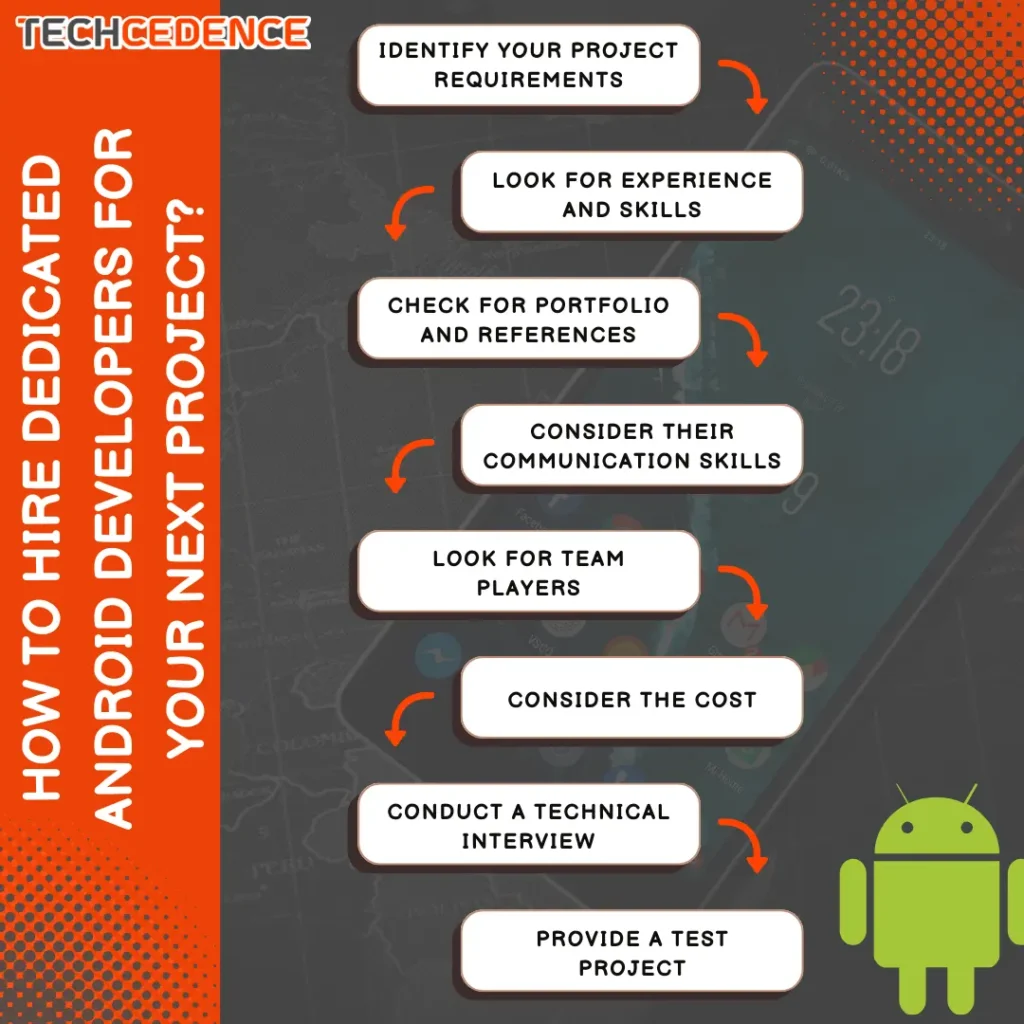
Hire dedicated android developers

1. Identify your project requirements

Before starting your search for an Android developer, you need to have a clear understanding of your project requirements. This includes the features, functionality, and user interface of your app. Once you have identified your project requirements, you can start searching for a developer who has the required skills and experience.

2. Look for experience and skills

When hiring an Android developer, it is essential to look for experience and skills. Look for developers who have worked on similar projects before and have a track record of delivering high-quality applications. Check for their skills in Android Studio, Java, Kotlin, and other essential technologies for Android app development. Also, look for developers who are familiar with the latest trends in Android application development and can implement them in your app.

3. Check for portfolio and references

Checking a developer’s portfolio and references is a crucial step in the hiring process. A portfolio showcases a developer’s skills and experience in developing Android applications. It provides you with a glimpse of their work and helps you understand their style and approach to app development. References, on the other hand, give you an idea of how the developer works with clients and their level of professionalism.

4. Consider their communication skills

Effective communication is critical when working with developers. You want someone who can communicate effectively with you and your team throughout the project. Check for their communication skills during the hiring process, and make sure they are responsive and available to answer any questions you may have.

5. Look for team players

When hiring an Android developer, it is crucial to look for someone who can work well with your team. Developers who are team players can collaborate effectively with other members of your team and contribute to the project’s success. Look for developers who are open to feedback, can communicate their ideas clearly, and are willing to work with your team to achieve your project’s goals.

6. Consider the cost

The cost of hiring an Android developer can vary depending on their experience and location. When considering the cost, make sure to weigh it against the developer’s experience, skills, and the scope of your project. A low cost may seem appealing, but it may not necessarily result in a high-quality application.

7. Conduct a technical interview

A technical interview is a crucial step in the hiring process. It helps you evaluate the developer’s technical skills and knowledge. During the interview, ask them questions related to Android application development, such as their experience with Android Studio, their knowledge of Kotlin or Java, and their experience with app architecture patterns like MVP, MVVM, or Clean architecture.

8. Provide a test project

Before hiring a developer, you can provide a small test project to evaluate their skills and approach to application development. A test project allows you to see how the developer works, their level of professionalism, and their ability to meet deadlines.

Conclusion

In conclusion, hiring dedicated Android developers for your next project requires careful consideration. By following the steps outlined above, you can identify the right developer for your project and ensure its success. Remember to focus on experience, skills, communication, teamwork, cost, and technical knowledge during the hiring process. With the right developer on board, you can create a high-quality Android application that meets the needs

Categories
Technology

Vue vs React vs Angular: Which is the Best Choice for your Project?

If you’re planning to develop a web application, you might have heard about Vue, React, and Angular. These three are the most popular and widely used frontend frameworks among web developers. Each of these frameworks has its own advantages and disadvantages, and choosing the right one can be a daunting task. In this blog post, we’ll compare Vue, React, and Angular to help you decide which one is the best choice for your project.

Vue.js

Vue.js is a lightweight and progressive JavaScript framework used for building user interfaces. It was created by Evan You in 2014 and has gained popularity because of its simplicity and ease of use. Vue.js is a reactive framework that updates the view automatically when the data changes.

One of the significant advantages of Vue.js is its small size, which makes it an excellent choice for building small to medium-sized applications. Vue.js is also easy to learn, and you can get started with it quickly, even if you’re a beginner. Vue.js has a comprehensive documentation and an active community that provides support and assistance to developers.

Another advantage of Vue.js is its flexibility. You can integrate Vue.js with other libraries and frameworks like React or Angular, which makes it an excellent choice for developing hybrid applications. Vue.js also supports server-side rendering, which improves the performance of web applications.

React

React is a popular JavaScript library for building user interfaces. It was created by Facebook in 2011 and is widely used by large companies like Netflix, Airbnb, and Instagram. React uses a virtual DOM, which improves the performance of web applications by reducing the number of DOM manipulations.

One of the significant advantages of React is its performance. React uses a virtual DOM, which makes it faster than other frameworks like Angular. React also has a large community that provides support and assistance to developers.

React is also flexible and can be used with other libraries and frameworks. You can use React with Vue.js or Angular to develop hybrid applications. React also has a vast ecosystem of third-party libraries and tools that make it easy to develop complex web applications.

Angular

Angular is a popular JavaScript framework for building web applications. It was created by Google in 2010 and is widely used by large companies like Microsoft, IBM, and PayPal. Angular is a full-featured framework that provides everything you need to develop complex web applications.

One of the significant advantages of Angular is its robustness. Angular provides a complete solution for building web applications, including data binding, forms, and routing. Angular also has a large community that provides support and assistance to developers.

Angular also has excellent performance. Angular uses a virtual DOM, which makes it faster than other frameworks like Vue.js. Angular also provides server-side rendering, which improves the performance of web applications.

Vue vs React vs Angular

Now that we’ve looked at the advantages of each framework, let’s compare them to help you decide which one is the best choice for your project.

Learning Curve

When it comes to the learning curve, Vue.js is the easiest to learn. Vue.js has a small API and is straightforward to understand, even if you’re a beginner. React and Angular, on the other hand, have a steeper learning curve. React uses JSX, which can be challenging to learn, and Angular has a lot of concepts that you need to understand before you can start developing web applications.

Performance

When it comes to performance, React and Angular are the clear winners. React uses a virtual DOM, which makes it faster than Vue.js. Angular also uses a virtual DOM and provides server-side rendering, which improves the performance of web applications.

Flexibility

When it comes to flexibility, Vue.js is the clear winner. Vue.js is a lightweight framework that can be easily integrated with other libraries and frameworks. React and Angular are also flexible, but they have a slightly steeper learning curve when it comes to integration with other technologies.

Robustness

When it comes to robustness, Angular is the clear winner. Angular provides a complete solution for building web applications, including data binding, forms, and routing. React and Vue.js are more focused on the view layer and require additional libraries for routing and state management.

Community and Ecosystem

All three frameworks have active communities that provide support and assistance to developers. However, React has the largest ecosystem of third-party libraries and tools. Vue.js also has a vibrant ecosystem, but it is not as large as React’s. Angular also has a large ecosystem, but it is more focused on enterprise applications.

Which one is the best choice for your project?

The answer to this question depends on the specific requirements of your project. If you’re building a small to medium-sized application and want a lightweight and easy-to-learn framework, Vue.js might be the best choice. If you’re building a large application that requires excellent performance and a large ecosystem of third-party libraries, React might be the best choice. If you’re building an enterprise-level application that requires a complete solution for building web applications, including data binding, forms, and routing, Angular might be the best choice.

Conclusion

Vue.js, React, and Angular are all excellent frontend frameworks that have their own advantages and disadvantages. The best choice for your project depends on the specific requirements of your application. Vue.js is a lightweight and easy-to-learn framework that is an excellent choice for small to medium-sized applications. React is a popular and performant framework that has a large ecosystem of third-party libraries and tools. Angular is a robust framework that provides a complete solution for building web applications, including data binding, forms, and routing. Whatever framework you choose, make sure to take the time to learn it properly and follow best practices to ensure the success of your project. For any further information, visit – https://techcedence.com/ 

Categories
Development

Why are JavaScript Frameworks Leading the Pack for Frontend Development?

Have you realized Facebook, LinkedIn, Instagram, and Google have one thing in common? And what is it? Their interactivity and engagement. These two factors have made an integral part of our digital routines. 

But did you ever wonder what makes these platforms engaging, successful, and an inseparable aspect of the web? Of course, there isn’t one but many. And one among them is that they use JavaScript! Let’s learn how JavaScript drives the success of the websites and online platforms of many such global enterprises. 

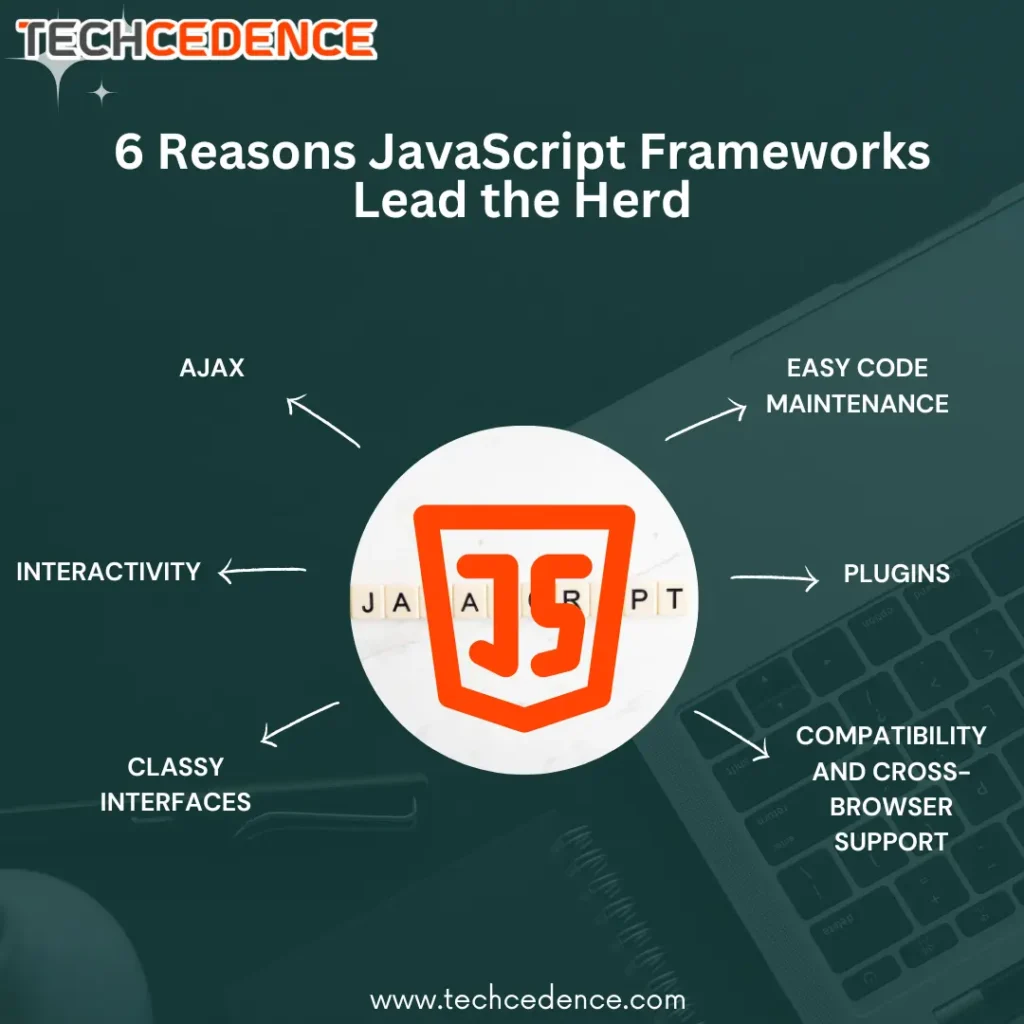
6 Reasons JavaScript Frameworks Lead the Herd

As one of the leading JavaScript frontend development companies, we consider these reasons vital in making JavaScript the top frontend development framework.

Reasons JavaScript Frameworks Lead the Herd

1. AJAX

AJAX is Asynchronous JavaScript and XML. So, what does AJAX do? It enables interaction between a webpage and the web server in the background without a page reloading. 

For instance, let’s consider a listing of events on a particular webpage. The system sorts them according to month, the most recent, and then categorizes them by their type. 

When the developer changes the ‘ALL’ filter to the ‘General’ one, the system triggers an operation in the background. That enables the page to reload partially with the newly queried items. And, while doing so, it doesn’t flicker. Thus, you remain exactly where you are, which precisely makes up for an amazing and stable web experience.

2. Interactivity

JavaScript can perform various functions for a website. It can enable the developer to build rich UI components like pop-ups, image sliders, form validations, navigation mega menus, etc. Additionally, the framework provides extra functionality to the site, which isn’t possible with HTML or CSS alone. Furthermore, JavaScript enables webpages to respond to user activity and update themselves without a page reload.

3. Plugins

Some websites include chat support, content suggestions, banner ads, social sharing, etc. They are likely to be powered by a third-party JavaScript plugin. Generally speaking, these plugins offer various configurable options that demand an additional set-up to function appropriately. They are usually aimed at integrating with little to no modification. Developers should comprehensively understand these plugins to use them efficiently and effectively.

4. Easy Code Maintenance

JavaScript has the Model View Controller (MVC) mechanism that helps you organize your code efficiently and keep it clean. It breaks down the website into three parts – data (Model), data’s presentation to the user (View), and action taken on user interaction (Controller). The categorization helps keep the codes structured in JavaScript.

5. Classy Interfaces

This is another significant benefit. JavaScript’s various interfaces enable developers to develop elegant and gripping web pages. It allows them to integrate drag-and-drop components or sliders that provide the webpage with a rich and classy interface. As a result, users enjoy an enhanced interactive webpage experience.

6. Compatibility and Cross-Browser Support

Leading browsers like Google Chrome, Mozilla Firefox, and Internet Explorer have inbuilt JavaScript capabilities. Thus, as a company, you enjoy improved compatibility and seamless cross-browser support. Besides, you don’t have to download a particular plug-in or install separate software to view JavaScript, as was the case earlier.

Leverage JavaScript to deliver phenomenal web experiences with Techcedence! Our extensive experience and capabilities in JavaScript can help you build an interactive and engaging frontend that redefines user journeys. Connect with us at sales@techcedence.com to learn more about the value proposition.

Categories
Hire Our Resources

Hiring Dedicated Node.js Developers in 2023: Steps, Benefits, and Challenges

Node.js, a cross-platform and open-source server environment, is known for its benefits like code sharing and reuse, several free tools, optimal speed, performance, etc. It is one of the most used web frameworks, with a developer respondent base of nearly 48 percent. No wonder many companies worldwide look to leverage Node.js!

However, to make the most of Node.js and its benefits, you need the right set of Node.js developers. But how do you do that, and what challenges might you encounter during the Node.js hiring venture? Here’s a blog that acquaints you with some.

How to Hire Node.js Developers?

So, how to hire Node.js developers? Here are the steps involved in it.

  • Create a Proper Job Description

The first step toward hiring the best-suited Node.js developers for your project is writing the right job description. The idea is to set the expectations right to receive applications closely aligned with your requirement.

  • Specify the Employment Type

The next step is to specify the employment type you intend to offer. It depends on your project requirement. Mentioning the employment type – in-house full-time, contractual, part-time, or freelancing will help you receive applications accordingly. 

Not doing so may lead to potential mismatches. You may spend much of your time filtering applications that match your requirement.

  • Search for the Best-Suited Node.js Developers

The next step is to float the requirement in the employment market, connecting with recruitment agencies and finding the best match for your requirement.

  • Shortlist and Interview

While your specific requirement and recruitment partners will help you receive applications best aligned with your needs, you may still be required to shortlist the best of the lot. Once you do that, the next step, of course, is to interview them. 

Design an interview that tests the candidates on multiple parameters like approach, personality, technical expertise, reliability as a professional, etc.

  • Outsource Node.js Hiring to Experts

Hiring the best Node.js developers can sometimes get complex and time-consuming. Besides, hiring Node.js developers from a particular region may be challenging, especially when you don’t belong to it. A smarter alternative to conventional hiring is outsourcing the recruitment part to expert companies.

These companies can serve as comprehensive Node.js development partners, helping you hire the right candidates and end-to-end project completion. Outsourcing helps save costs and time, ensures quick scalability, and helps your focus on your core business.

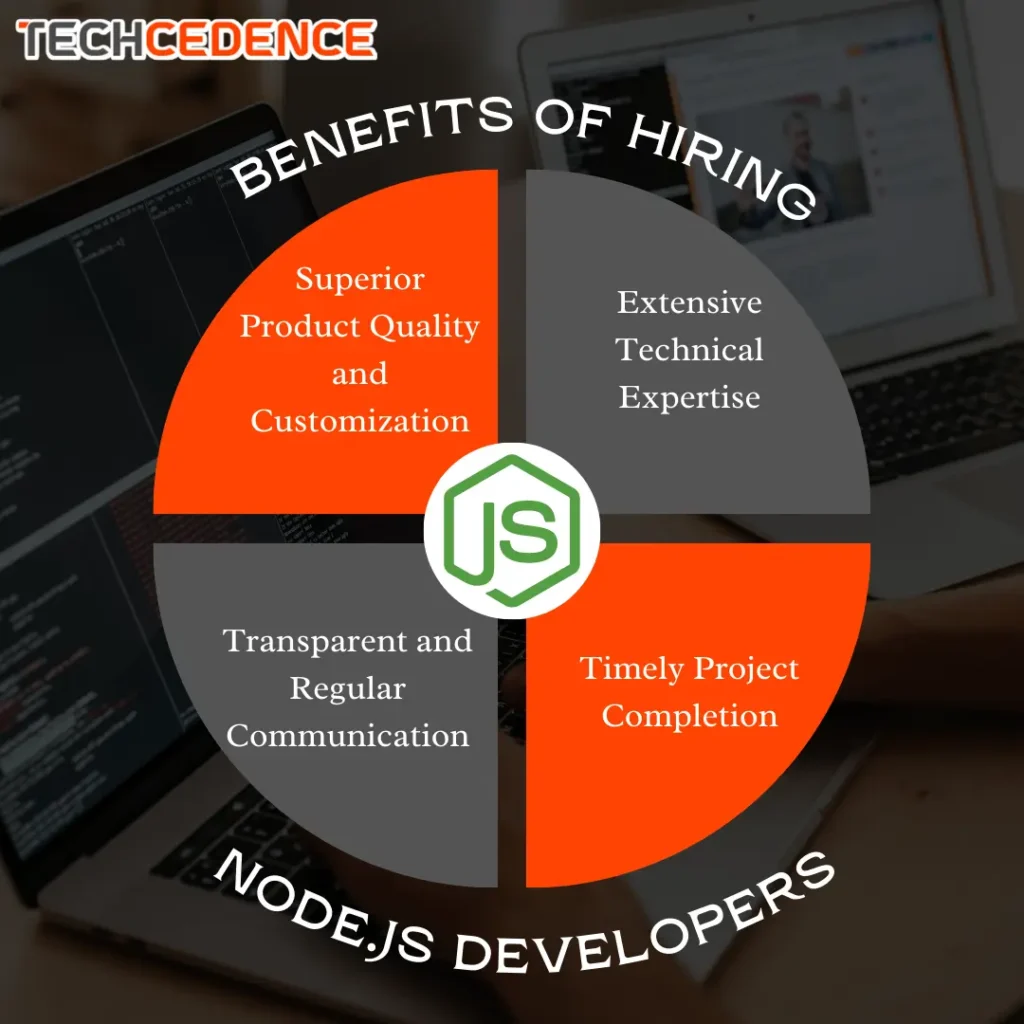
Benefits of Hiring Node.js Developers?

Here are some advantages of hiring qualified and experienced Node.js developers.

Benefits of Hiring Node.js Developers
  • Superior Product Quality and Customization

Expert and seasoned Node.js developers with a comprehensive understanding of client’s needs can contribute to better product quality. Besides, their extensive capabilities can help you customize the product to your needs. 

  • Extensive Technical Expertise

Specialist and competent Node.js developers possess extensive technical expertise. They are abreast of the latest technology and trends, and updates in their realm of work. This proves advantageous for companies that hire them. It refers to competent onboarding talent that helps them build resonating applications.

  • Transparent and Regular Communication

Professional and capable Node.js developers provide regular updates and ensure communication transparency throughout. It helps you, as the employer, or the client, keep track of the project’s progress.

  • Timely Project Completion

This is another significant advantage of hiring professional Node.js developers. Having the right set of dedicated Node.js developers help you ensure timely project completion, and save considerable costs, especially when you hire Node.js developers via outsourcing companies, where the service provider bears the employment costs.

Potential Challenges in Hiring Node.js Developers

Some challenges that you may confront while hiring Node.js developers include the following. Of course, partnering with the right company that helps you find the right Node.js developers can resolve those challenges. But knowing what can impede your Node.js endeavors can help you prepare for it proactively.

  • Lack of access to a broader pool of Node.js talent
  • Inability to find the best-suited candidates
  • Redundant talent acquisition strategies
  • High hiring costs
  • Unclear job requirement
  • Poorly organized interview process and rounds

Looking for Node.js Developers? Hire Them Through Techcedence!

India is one of the world’s largest reservoirs of Node.js developers. While scoring high on qualifications and experience, India’s Node.js developers are cost-effective and result-oriented. At Techcedence, we can help you hire Node.js developers aligned with your requirement. So, don’t struggle with hiring Node.js developers. Hire the right ones effortlessly with us. Please email us at sales@techcedence.com to know more.

Categories
Development

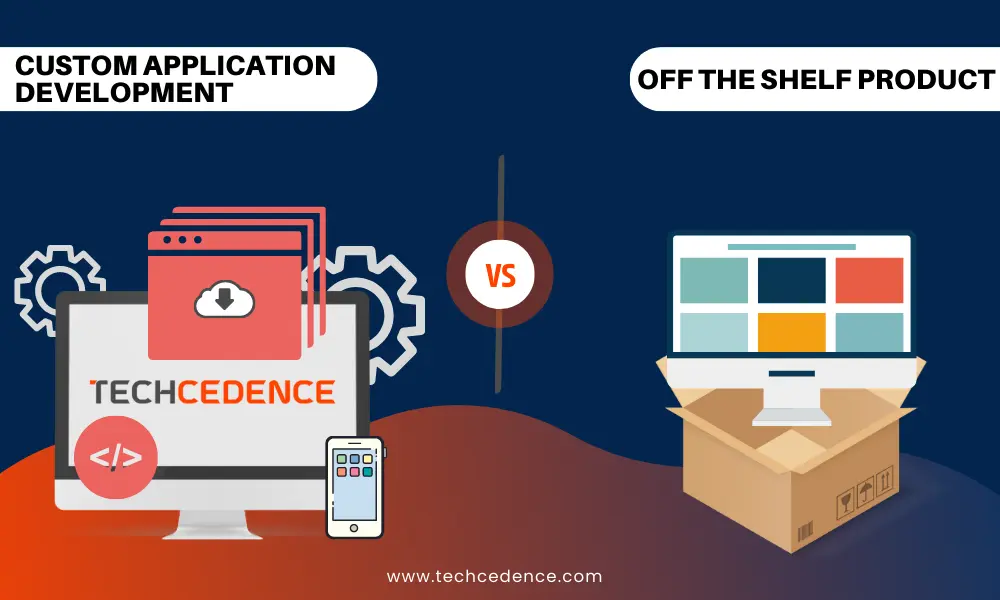
Off the Shelf Product Vs. Custom Application Development

Whether to go for an off-the-shelf product, which is ready-to-use (and perhaps a plug-and-play solution), or a custom application development, which will demand investment, take time to shape but tailored to your needs? 

Almost every business, especially startups and SMEs with various constraints, confronts this question at some point. So, which one is a better choice? Is there a generic answer to this question, or should business owners take a situation-based call? Let’s find out.

What is an Off-the-Shelf Product?

An off-the-shelf software application is a readymade product ready to go out of the box. It is available to everyone and includes various features, out of which some or perhaps, all will be useful for a particular business. They aren’t tailored to a particular business’s needs. Hence, they follow the one-size-fits-all approach. 

Some common examples of off-the-shelf software applications include CRM, accounting applications, email services, operating systems, etc.

What is a Custom Application?

Bespoke application is a broad area and the default norm these days. Every business is unique, and hence comes with varying needs. So, using an off-the-shelf product seldom works. Businesses use custom application development to build software solutions aligned with their workflows. The tailored software application requires partnering with a custom software application development company to develop the solution.

Pros and Cons of Off-the-Shelf Products

Let’s look at some pros and cons of off-the-shelf products.

Pros of Off-the-Shelf Products

  • Readymade
  • Much more cost-effective than bespoke software
  • Save time and effort
  • Have user communities for assistance and guidance
  • Tested and proven solutions
  • Have a name and reputation in the market
  • Comprehensive enough to meet various business needs

Cons of Off-the-Shelf Products

  • It cannot be customized, or customization could be expensive
  • Some features and functionalities may be useless for a particular business
  • Slower to adapt to the changing industry needs
  • Updates and upgrades are controlled by the application’s makers

Pros and Cons of Custom Applications

Here are some advantages and disadvantages of tailored applications

Pros of Custom Applications

  • Highly customizable
  • Ownership remains with the client company
  • Greater scalability
  • A higher degree of security
  • Upgrades, updates, and changes are quick and more straightforward
  • Integration of customized features and functionalities
  • More aligned with business needs

Cons of Custom Applications

  • A high initial investment involved
  • Risk of a misaligned final product
  • Requires time to be developed
  • Not tested for all business cases
  • Problems are discovered by the user
  • Absence of community support

Off-the-Shelf vs. Custom Application Development – What Should I Choose?

So, we now come to the main question – off-the-shelf vs. custom application development – what to choose? Honestly, we will suggest you go for a custom application. Of course, we’ve listed the pros of custom applications. Yes. It also requires time and money to develop. But business matters more than everything else! 

So, suppose you are looking for an app synchronized with your business needs and objectives and a higher return on investment. In that case, a custom application is an option to choose from. 

But wait. Don’t rush to make a decision. Custom software applications may not necessarily be the right option. Off-the-shelf products work when you are fine with standard features, the business operation associated with the application isn’t as critical or requires customized functionalities, you don’t have time or the financial muscle to invest in a customized application, or you don’t need a custom software at the moment.

Nevertheless, if you are sure about your choice and need a custom application tailored to your needs, partner with Techcedence, one of the leading custom application development companies. Our extensive portfolio comprises bespoke app development for multiple domains. We develop applications after a thorough discussion of your business needs and objectives. Our support involves everything from conceptualization to maintenance and technical support.

Thus, choose Techcedence if you are looking for higher RoI on your investments and a tailored application stitched to your needs. Email us at sales@techcedence.com to learn more about our custom application development services.