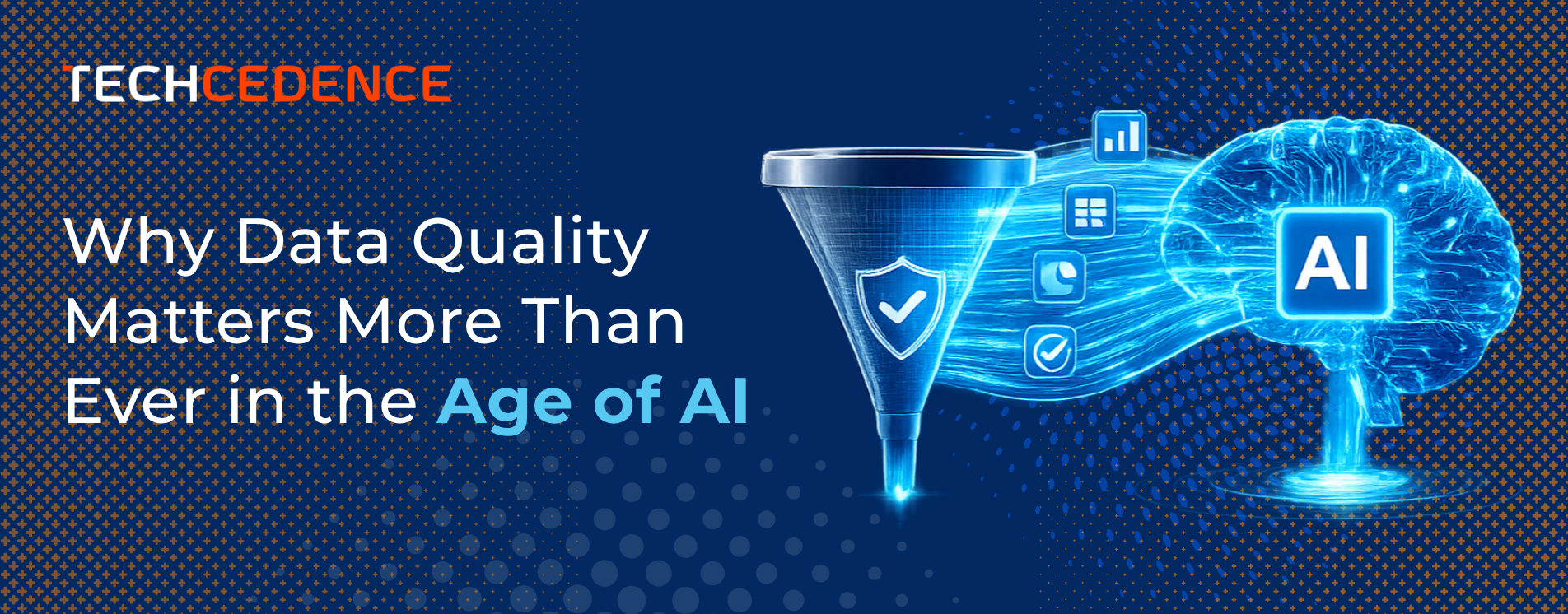
Why Data Quality Matters More Than Ever in the Age of AI
Artificial intelligence has moved well past the hype stage. Businesses across industries are actively deploying AI to automate decisions, predict outcomes, and drive efficiency. The investment is real, and the pressure to move fast is enormous. But there is a problem quietly sitting underneath many of these initiatives: the data feeding these AI systems is often not good enough. And in the age of AI, that gap between data ambition and data reality is becoming very expensive.
The Foundation Nobody Fixed
The rush toward AI adoption has exposed something that many organizations have been able to ignore for years. Data problems that were once manageable have now become serious liabilities. Duplicate records, inconsistent formats, information locked in departmental silos, systems that never quite talked to each other. All of it has been left unresolved for too long.
Before AI, bad data meant a flawed report or a confused spreadsheet. A human would spot the anomaly and correct it. Now, bad data gets fed into models that make decisions automatically, at speed, and at scale. The tolerance for data quality issues has dropped sharply, but most organizations have not upgraded their data practices to match. That mismatch is where AI projects stall, underperform, or quietly mislead the people relying on them.
What Is Actually Going Wrong
The oldest rule in technology still applies: Garbage in, garbage out. It was true when it was first said about early computing, and it is just as true today. AI models learn from the data they are trained on. If that data is incomplete, inconsistent, or simply wrong, the model will learn the wrong things and produce outputs that reflect those flaws. The difference now is the scale. A flawed AI model does not make one bad recommendation. It makes thousands of them, often before anyone notices something is off.
Silos create blind spots
Many organizations find their data distributed across various systems, tools, and teams, which seldom exchange information seamlessly. Sales data lives in one place, customer support in another, operations in a third. AI needs a connected, consistent view of information to function well. When data is fragmented, models end up working with an incomplete picture, and the outputs reflect that incompleteness. Silos were always inefficient. In an AI-driven environment, they actively undermine the quality of decisions.
Bias does not come from the algorithm
One of the more persistent misconceptions about AI bias is that it originates in the algorithm itself. In most cases, it does not. It comes from the data. If historical data reflects past imbalances, gaps, or discriminatory patterns, an AI model trained on that data will learn and replicate those patterns. Organizations that skip the step of auditing their data for these issues are not building neutral AI systems. They are encoding old problems into new technology, often at a scale that makes them harder to reverse.
Real-time AI needs real-time quality
Many of the most valuable AI applications today operate on live data. Customer behaviour signals, inventory levels, financial transactions, operational metrics. These systems do not have the luxury of a weekly data cleaning run. Quality needs to be enforced as data enters the pipeline, not corrected after the fact. That requires a fundamentally different approach to how data infrastructure is designed and maintained.
What This Means for Your Business
The business consequences of poor data quality in an AI context go beyond technical performance. When AI outputs are unreliable, trust erodes quickly. Teams stop relying on the system, work around it, and the investment loses its value.
On the other side, organizations with strong data foundations deploy AI faster and make decisions with greater confidence. Clean, well-governed data is not just a technical advantage. It is a competitive one.
Data quality is also becoming a governance issue that leadership cannot delegate. Regulators are increasingly focusing on the construction of AI systems and the foundations upon which they are established. Organizations that cannot demonstrate data integrity face not just poor outputs but legal and reputational risk.
Building the Right Foundation
Improving data quality for AI is not a one-time project. It is an ongoing practice that needs to be built into how an organization manages information at every level.
It starts with understanding what data you actually have. A thorough audit across systems, sources, and departments reveals where quality is strong, where it breaks down, and where the gaps are largest. From there, data governance policies establish clear ownership, define quality standards, and create accountability for maintaining them over time.
The next step is embedding quality into the data pipeline itself. Rather than cleaning data after it has been collected and stored, the goal is to enforce standards at the point of entry so that problems are caught before they propagate. This transition from reactive to proactive data handling greatly impacts the dependability of all subsequent processes.
This is where the right technology partner matters. Techcedence helps businesses build the data infrastructure and governance frameworks that give AI a reliable foundation to work from. Through its Data Analytics and Business Intelligence services, Techcedence helps organizations move from raw, scattered information to structured, insight-ready data. That means AI models built on inputs they can trust, and decision-makers with dashboards and reports that accurately reflect what is happening in the business.
The Asset Businesses Cannot Afford to Overlook
AI is genuinely changing how businesses operate, but the transformation only holds if the data underneath it is trustworthy. A powerful model built on weak data is still a weak model. The businesses taking data quality seriously now are the ones building AI they can actually rely on, not just demonstrate.
In the age of AI, clean and well-governed data is not a background technical concern. It is a strategic asset, and the organizations that treat it that way will find their AI investments deliver what they promised.