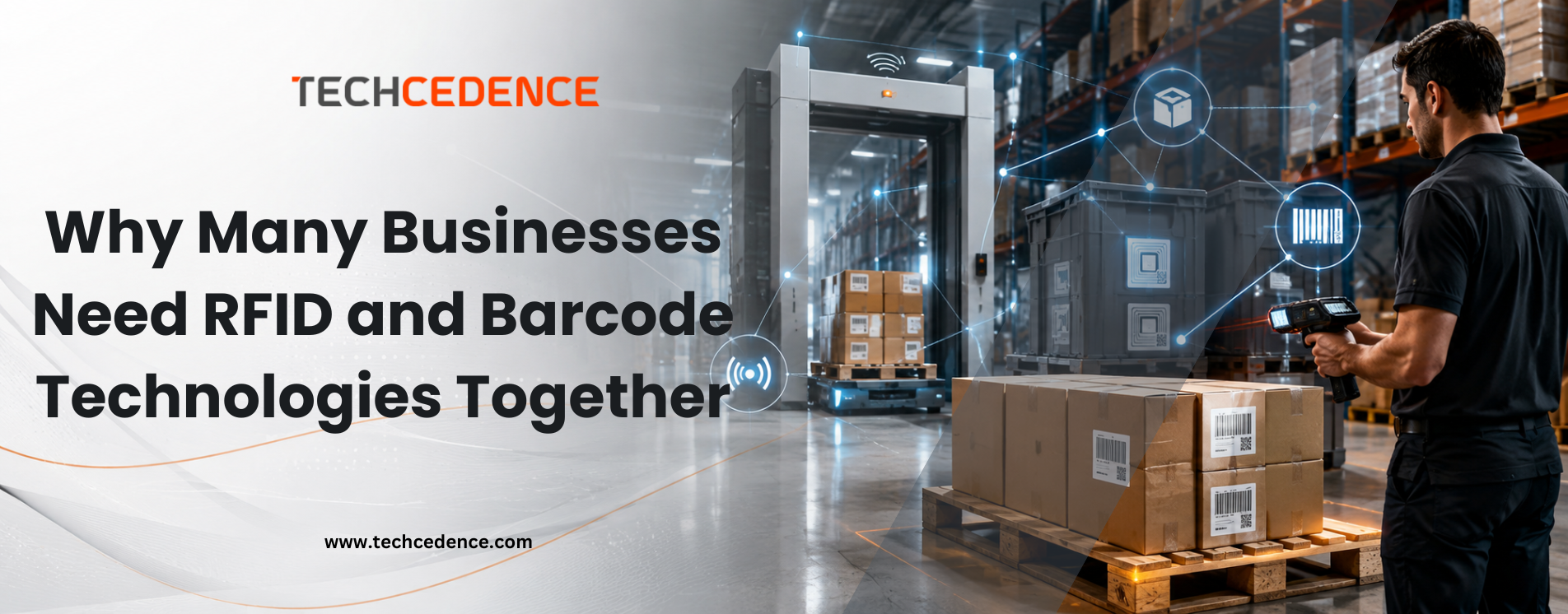
Why Many Businesses Need RFID and Barcode Technologies Together
Barcode and RFID technologies are often presented as competing solutions for inventory and asset tracking. This comparison can make businesses believe they need to choose one technology over the other. In reality, each serves a different purpose and addresses specific operational requirements.
Many organizations achieve better visibility and efficiency by using both technologies together. Barcodes provide a reliable and cost-effective way to identify and manage items, while RFID enables faster, automated tracking where real-time visibility is essential. By recognizing the advantages of each, companies can develop a tracking strategy that benefits both present activities and future expansion.
Why the Comparison Is Often Misleading
Comparing RFID and barcode technologies as alternatives oversimplifies how modern tracking systems work. While both help identify and monitor assets or inventory, they operate differently and are designed to solve different business challenges.
Barcodes require items to be scanned individually, making them well suited for structured processes where manual verification is acceptable. RFID, on the other hand, enables automatic identification of multiple tagged items without direct line-of-sight, making it ideal for environments that require faster tracking and real-time visibility.
Rather than replacing one technology with the other, businesses should evaluate where each delivers the greatest operational value. In many cases, combining both creates a more practical and efficient tracking strategy.
Where Barcodes Continue to Deliver Value
Despite the growing adoption of advanced tracking technologies, barcodes remain a practical and effective solution for many business operations. They are simple to implement, cost-effective, and well-suited for environments where items can be scanned during defined workflow stages.
Barcodes are widely used for product identification, inventory counts, receiving and dispatch operations, and asset labeling. They provide reliable tracking while requiring minimal infrastructure, making them an excellent choice for organizations with straightforward inventory processes or budget constraints.
For many businesses, barcode technology continues to deliver the accuracy and control needed for day-to-day operations. Its proven reliability makes it an important component of a broader tracking strategy rather than an outdated technology.
Where RFID Adds Greater Operational Visibility
RFID extends tracking capabilities by reducing the need for manual scanning and providing greater visibility into the movement of assets and inventory. Since RFID tags can be read automatically without direct line-of-sight, multiple items can be identified simultaneously, helping businesses process large volumes more efficiently.
This makes RFID particularly valuable in environments where speed, accuracy, and real-time information are critical. It allows businesses to track asset movement, enhance inventory precision, and decrease the duration spent on regular tracking tasks.
For businesses managing high-value assets, large inventories, or fast-moving operations, RFID provides the visibility needed to make quicker decisions and maintain better control over day-to-day processes.
Why Hybrid Tracking Delivers Better Results
The most effective tracking strategies are built around operational needs rather than a single technology. By combining barcodes and RFID, businesses can use each where it delivers the greatest value.
For example, barcodes can support routine tasks such as receiving goods, labeling products, and periodic inventory counts. RFID can be used to monitor high-value assets, automate inventory checks, or track the movement of items through critical areas. This approach improves visibility without requiring organizations to replace their existing barcode systems.
A hybrid tracking strategy allows businesses to enhance efficiency gradually, maximize existing investments, and adopt advanced capabilities where they have the greatest impact.
Business Benefits of Using Both Technologies
Combining RFID and barcode technologies allows businesses to build a tracking system that is both practical and scalable. Instead of relying on a single method for every process, organizations can use the technology best suited to each operational requirement.
This approach improves inventory accuracy, reduces manual effort, and provides greater visibility across assets and stock movements. It also helps streamline workflows by automating tracking where speed is essential while retaining the simplicity of barcode scanning for routine tasks.
By combining the advantages of both technologies, companies can enhance their operational efficiency, make more informed decisions, and establish a versatile tracking system that can adjust as their requirements change.
Building an Integrated Tracking Environment
The true value of RFID and barcode technologies lies in bringing the data they generate into a single tracking platform. When information from both technologies is centralized, businesses gain a unified view of their inventory, assets, and operational activities instead of managing separate tracking systems.
An integrated approach helps eliminate information gaps, improves reporting accuracy, and enables faster decision-making. It also enables organizations to enhance their tracking abilities gradually without interrupting current workflows or needing to replace technologies that still provide value.
Techcedence’s RFID and Barcode Solutions help businesses integrate barcode and RFID technologies into a unified tracking environment, enabling greater visibility, improved operational efficiency, and a scalable foundation for future growth.
Choosing the Right Technology Mix
There is no one-size-fits-all approach to inventory and asset tracking. The right combination of RFID and barcode technologies depends on factors such as the type of assets being tracked, operational workflows, required visibility, and available budget.
Businesses should begin by identifying areas where manual processes slow operations or where greater visibility is needed. Barcode technology may continue to meet the needs of many processes, while RFID can be introduced in specific areas where automation and real-time tracking provide measurable benefits.
By adopting a phased approach and selecting the right technology for each use case, organizations can improve operational efficiency while making the most of their existing investments.
Conclusion
RFID and barcode technologies are not competing solutions but complementary tools that address different tracking requirements. While barcodes offer a reliable and cost-effective way to manage routine operations, RFID provides the automation and real-time visibility needed for more complex environments.
By combining both technologies, businesses can improve inventory accuracy, streamline operations, and build a tracking system that grows with their needs. An integrated approach enables organizations to maximize existing investments while adopting new capabilities where they deliver the greatest business value.