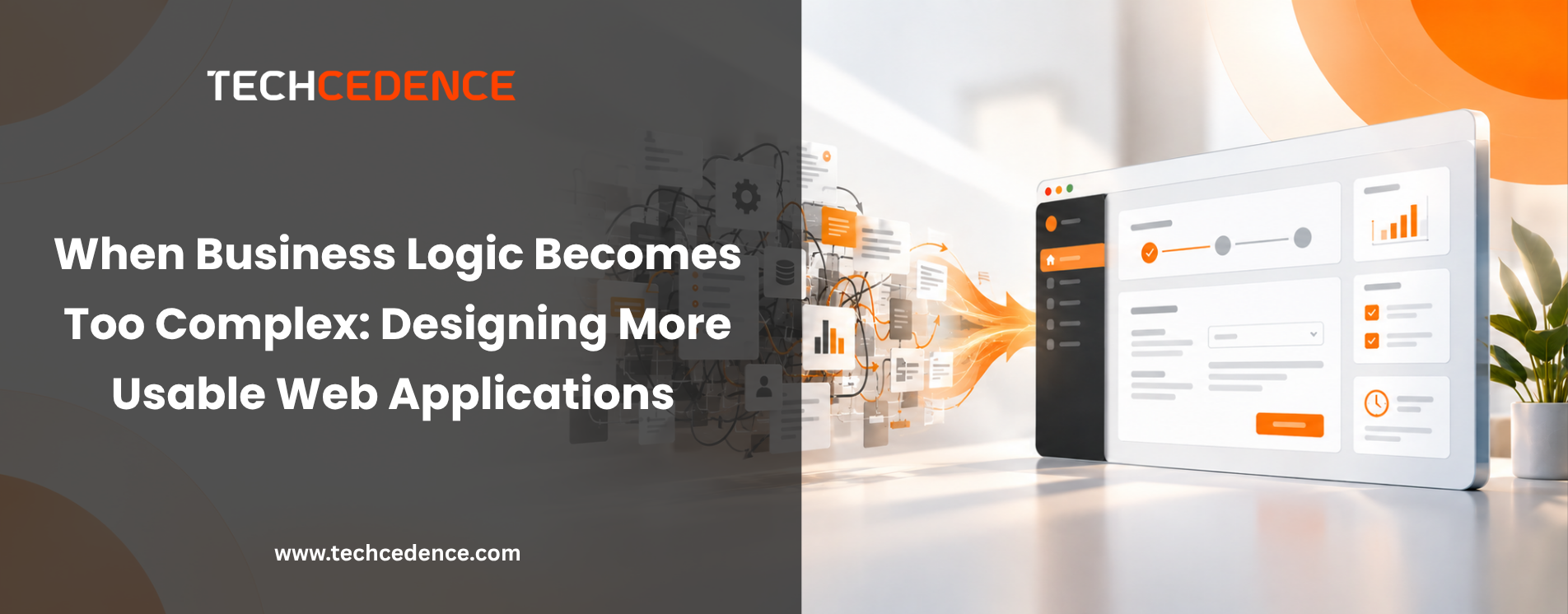
When Business Logic Becomes Too Complex: Designing More Usable Web Applications
Web applications evolve as businesses grow. New requirements, approval processes, permissions, and integrations are added to support changing operational needs. While these additions improve functionality, they can also make applications harder to understand and use.
The challenge is not necessarily the complexity of the business itself, but how that complexity reaches the user. When interfaces become crowded with options, workflows require unnecessary steps, or system responses are difficult to understand, even routine tasks can become frustrating.
Designing usable web applications requires a balance between supporting complex business requirements and keeping everyday interactions clear. The aim is to create systems that manage complexity on the inside, enabling users to accomplish their tasks with little resistance.
Why Business Logic Becomes Increasingly Complex
Business logic defines the rules, conditions, and decisions that govern how an application operates. As organizations expand, these rules often grow to accommodate new processes, regulatory requirements, user roles, and operational exceptions.
Over time, individual changes can introduce dependencies across different parts of an application. A modification to one workflow may affect another, while additional permissions and approval conditions can make system behavior harder to maintain. When these changes accumulate without a consistent design approach, the application can become difficult to manage and navigate.
Recognizing this growth is important because adding more functionality does not automatically make an application more effective. The next challenge is understanding how underlying complexity affects the people who use the system.
How Complex Business Rules Affect User Experience
When business rules are reflected directly in the interface without careful consideration, users may face excessive fields, unclear options, inconsistent navigation, and lengthy workflows. They may also struggle to understand why certain actions are unavailable or why additional information is required.
These difficulties increase the effort needed to complete routine tasks. Users may make avoidable mistakes, depend more heavily on training materials, or seek assistance for processes that should be straightforward.
Poor usability can therefore affect more than individual satisfaction. It can slow down operations, reduce adoption, and increase the support required to maintain the application. Addressing these issues begins with separating the complexity the system must manage from the information users actually need.
Separating Business Logic From Interface Complexity
A usable interface does not need to expose every underlying rule or system dependency. Business logic can remain within the application’s processing layer, while the interface presents only the information and actions relevant to the user’s current task.
This separation helps keep screens focused and interactions predictable. Conditional fields can appear when they become necessary, advanced options can remain hidden until requested, and irrelevant information can be excluded from a user’s view.
Progressive disclosure is one way to achieve this balance. By presenting essential information first and revealing additional details when needed, applications can support complex requirements without overwhelming users. However, simplifying the interface is only effective when the underlying workflow is also organized around how people need to work.
Designing Workflows Around User Tasks
Applications are often structured around internal departments, data models, or system functions. Although this organization may make sense technically, it does not always reflect how users approach their responsibilities.
Task-based design starts by identifying what users need to accomplish and arranging the interface around those goals. Related information should be grouped logically, unnecessary steps should be removed, and each stage should make the next action clear.
Consistent navigation and predictable interactions also reduce the effort required to learn and use an application. When users can understand where they are in a process and what is expected of them, complex workflows become easier to manage without removing necessary business controls.
Managing Rules With Clear Feedback and Validation
Even a well-organized workflow can become confusing when an application does not explain its decisions. Business rules should be accompanied by explicit feedback that aids users in comprehending the current situation and the actions they need to take next.
Validation messages should identify the issue and explain how to resolve it, rather than simply indicating that an action has failed. When a restriction applies, the interface should communicate the reason whenever appropriate. Consistent behavior across related screens also helps users develop confidence in the system.
These design decisions make business rules easier to follow without requiring users to understand the application’s internal logic. At the same time, organizations must ensure that simplifying interactions does not weaken necessary permissions, compliance requirements, or accountability.
Balancing Usability, Flexibility, and Control
Business applications often serve users with different responsibilities and access requirements. Giving everyone the same interface can create unnecessary complexity, while creating entirely separate experiences for every role can increase maintenance effort.
A more effective approach is to provide relevant information and actions based on user roles and permissions. This keeps interfaces focused while preserving the controls required by the business.
Flexibility should also be introduced carefully. Customization and advanced options can support varied needs, but excessive configuration may make the application inconsistent and harder to maintain. A clear design framework helps organizations accommodate changing requirements without sacrificing usability.
Making Usability an Ongoing Practice
Usability should be reviewed throughout an application’s lifecycle, not only before its initial release. As new features and business rules are introduced, teams need to assess how those changes affect existing workflows.
User feedback, usability testing, and application usage data can help identify areas where people encounter difficulty. These findings should guide improvements based on their impact on task completion, errors, and operational efficiency.
Involving business stakeholders, designers, and developers in these reviews helps ensure that new requirements are evaluated from both functional and user perspectives. This makes usability part of application evolution rather than a corrective step taken after problems emerge.
Conclusion
Complex business logic is often necessary, but complex user experiences are not. As web applications grow, their design must ensure that additional rules and capabilities do not make routine work unnecessarily difficult.
By separating internal logic from interface design, organizing workflows around user needs, providing clear feedback, and reviewing usability continuously, businesses can build applications that remain practical as requirements evolve.
The measure of a well-designed web application is not how much complexity it exposes, but how effectively it helps users complete their work.