Why Enterprise Data Architecture Is the Foundation of Scalable Analytics
Organizations rely on analytics to inform decisions in operations, finance, and customer engagement. As data volumes and reporting needs grow, scalable analytics solutions become essential. Without a structured data foundation, attempts to scale often lead to inconsistent results and reduced reliability.
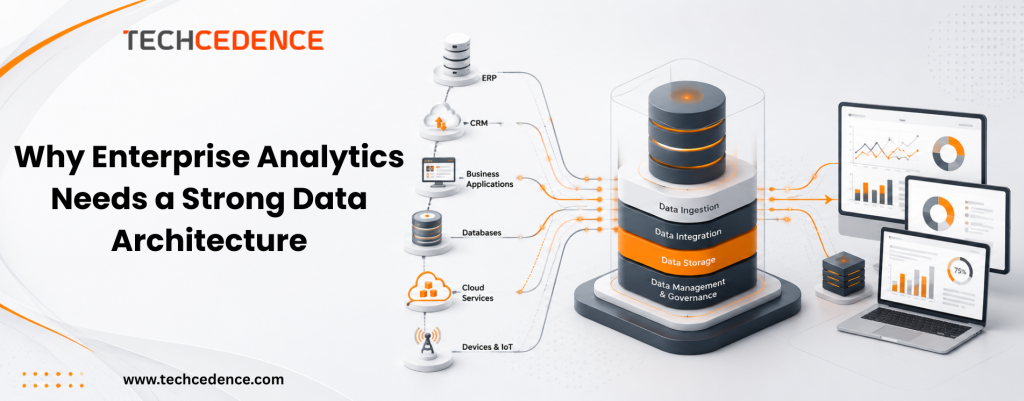
This is where enterprise data architecture is important. It provides a common framework for organizing, integrating, and managing data from multiple systems, enabling analytics to use consistent, reliable data to deliver accurate results. Without an established data architecture, analytics tools, and even advanced tools, organizations will have difficulty producing meaningful outcomes.
An established data architecture enables organizations to effectively scale analytics to meet current reporting needs and support future data-driven initiatives.
What Is Enterprise Data Architecture?
Enterprise data architecture is the method by which an organization structures, integrates, and manages its data. It defines how data will move between systems and the methods used to store and access data for analysis. The enterprise paradigm shifts from treating data as independent entities contained in specific applications to a cohesive framework that links data across the organization.
By adopting this method, enterprise data architecture helps create consistent, trustworthy data that can be used for analytical purposes, regardless of source. It also facilitates data access, allowing users to base decisions on a single set of information. Creating an enterprise architecture provides businesses with a solid foundation for ongoing growth and development in data analytics.
Limitations of Fragmented Data Systems
Organizations encounter difficulties reporting when data is spread across multiple systems with no unified format; for example, departments use different data sources, leading to conflicting information, multiple versions of the same metric, and difficulty finding a single source of truth.
In addition, fragmented systems create extra work to provide insights, as teams spend more time collecting, cleaning, and reconciling data rather than analyzing it. These inefficiencies increase as the demand for analytics grows, making reporting and decision-making more challenging to scale.
Maintaining accuracy, efficiency, and consistency in analytic architecture is problematic without a cohesive data architecture.
Why Scalable Analytics Requires a Strong Foundation
For scalable analytics, organizations can rely on accurate, consistent datasets to get value from their analytics. As more departments utilize analytics, there will be greater volumes of data of varying complexity, and without a structural foundation supporting their analytical growth, organizations may experience performance issues, inaccurate insights, and delayed reporting.
A well-structured data architecture will enable data to be structured, harmonized, and made available for analytical purposes. This allows analytic systems to efficiently process data for routine reporting or for more advanced uses. Furthermore, this structure enables an organization to provide timely insight into changing operations and markets.
Creating a solid foundation for data will allow companies to build out their analytic capabilities without sacrificing accuracy or performance.
Key Components of Enterprise Data Architecture
A scalable data architecture is built on a set of core components that ensure data is reliable, connected, and usable across the organization.
Data Integration
Integrating data from systems such as ERP, CRM, and operational platforms creates a unified view of the business. This reduces silos and ensures that analytics are based on complete and consistent information.
Data Storage and Management
Structured storage approaches allow organizations to handle growing data volumes efficiently. Proper data management ensures that information is organized and accessible for analysis.
Data Governance
Clear governance establishes standards for data quality, ownership, and usage. It helps maintain consistency and ensures that decision-makers can trust the insights generated.
Data Accessibility
Making data available to the right users at the right time is essential for effective analytics. Business intelligence tools and structured access frameworks ensure that insights can be used across teams without unnecessary delays.
Together, these components form the foundation for scalable and reliable analytics across the enterprise.
Role of Architecture in Enabling Advanced Analytics
A solid data architecture is the key to both the reliability and the feasibility of advanced analytics, including predictive models, real-time dashboards, and complex queries, which all depend on consistent, structured data. Without a solid foundation, providing these capabilities may lead to inconsistencies or make them difficult to manage.
When data is integrated and standardized, analytics systems can process more information much more quickly, increasing the efficiency of reporting tools and decreasing the time required to generate insights from reports, enabling organizations to progress from basic reporting to more sophisticated methodologies such as forecasting and trend analysis.
Enterprise data architecture enables organizations to expand their analytic capabilities by supporting efficient data processing and producing consistent results with high confidence.
Benefits for Organizations
Enterprise Data Architecture offers support when expanding analytical initiatives. The use of consistent, well-integrated data enables organizations to quickly access accurate information for faster, more informed decision-making. The leadership teams can more easily assess how well each department is performing, thereby enabling better strategic planning and resource allocation.
By using a robust Enterprise Data Architecture, operational efficiency improves because less time is spent preparing data, and more time is available for analysis. Reducing duplication and inconsistencies reduces error potential, while a standardized process for handling data across all divisions increases the ability to work together.
Additionally, a well-structured foundational data architecture will support long-term scalability. As new sources, tools, and use cases for Analytics are added, the Enterprise Data Architecture can allow for their integration into production without adversely affecting the operation of current systems, enabling organizations to grow their Analytics capabilities in a controlled and sustainable fashion.
Role of Data Analytics and BI Solutions
Creating the proper infrastructure to hold all your information is essential to getting the most value from it. While the underlying infrastructure serves as the foundation for organizing and structuring data, analytical solutions combined with business intelligence (BI) tools enable you to leverage your data.
When combined with a structured data foundation (data architecture), the use of disparate analytical platforms enables you to analyze your data, identify patterns in your performance, and forecast future events while maintaining clear visibility into your Key Performance Indicators (KPIs)through BI tools.
Organizations often rely on partners such as Techcedence to implement data analytics and BI solutions that align with their architecture. By integrating analytics capabilities with a structured data foundation, businesses can ensure that insights remain consistent, scalable, and aligned with their strategic goals.
Conclusion
Data architecture has gone from being a purely technical consideration to an organizational strategic foundation for scaling up your analytic capabilities. As data increasingly informs decision-making, having a single place for consistency, integration, and access becomes critical, especially with a well-structured architecture; this way, analytics efforts won’t be fragmented or difficult to scale.
With a strong data foundation for building analytics systems, organizations will be able to create accurate, timely, and aligned across the organization analytic reports, enabling them to make decisions with confidence and continue building their analytic capabilities as their business needs change. All these are reasons why, in a data-driven world, a well-designed enterprise data architecture is crucial for developing dependable, scalable analytic solutions.