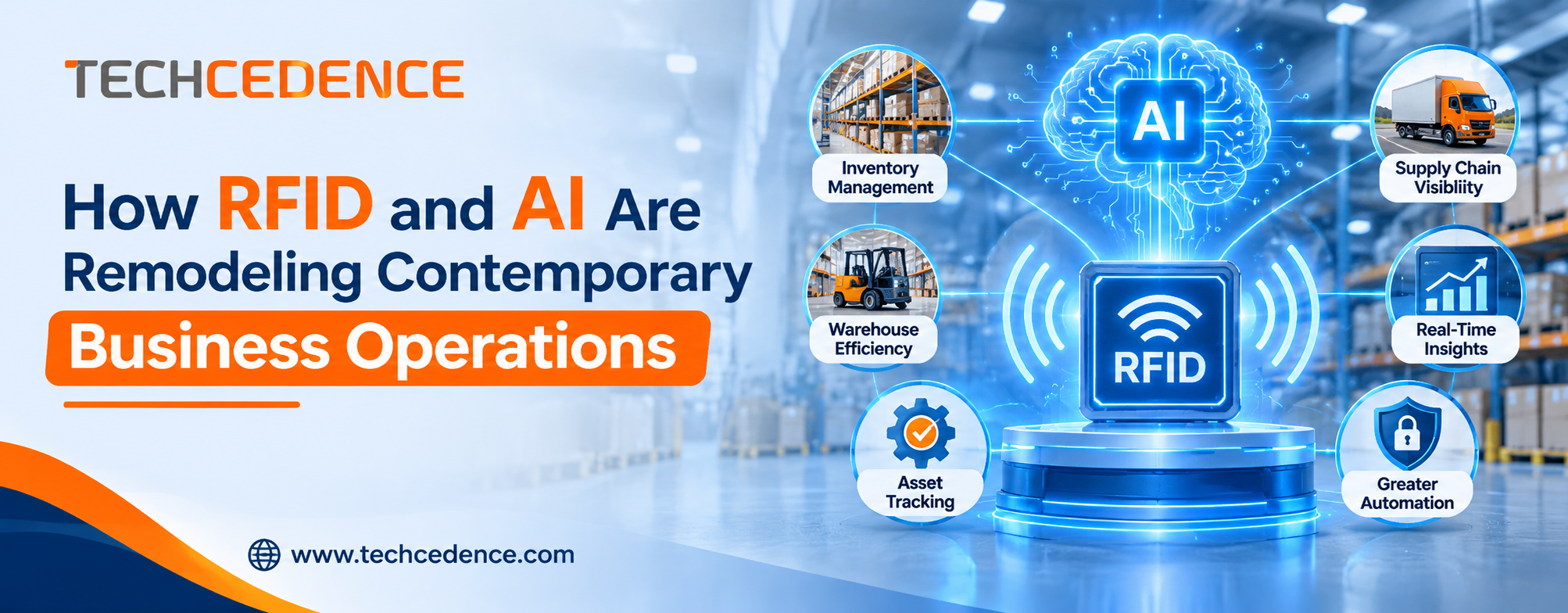
How RFID and AI Are Remodeling Contemporary Business Operations
Businesses are increasingly adopting digital technologies to gain better operational control, reduce inefficiencies, and improve productivity. As supply chain problems grow and customer expectations rise, access to accurate, real-time operational information has become essential. Traditional methods for tracking inventory, scanning assets, and managing warehouse activities often struggle to meet these demands.
Radio Frequency Identification (RFID) and Artificial Intelligence (AI) help organizations meet these challenges. RFID enables automatic identification and monitoring of products, equipment, and other physical assets. AI builds RFID data, using analytics and machine learning to find patterns, predict needs, and support better business decisions.
Blending these technologies helps organizations create smarter workflows, improve operational visibility, and automate processes that once needed considerable manual effort.
How RFID and AI Work Together
RFID technology uses radio frequency signals to identify objects with electronic tags. These tags communicate with RFID readers, capturing information about products, equipment, and assets without requiring individual barcode scans or direct visual contact.
Artificial Intelligence adds an analytical layer to this process. It examines collected information, recognizes recurring patterns, identifies irregularities, and generates insights that help businesses plan their next actions.
Together, they create a continuous flow of information between physical operations and digital systems.
Consider a warehouse where RFID readers automatically register for incoming and outgoing products. AI can analyze this information alongside sales trends and historical consumption data to estimate future demand, highlight products at risk of running out, and suggest appropriate stock levels.
This integration turns routine tracking information into intelligence that businesses can use to improve operations.
6 Key Ways RFID and AI Can Improve Business Operations
1. More Accurate and Intelligent Inventory Control
Maintaining accurate inventory levels across numerous locations is a significant operational challenge. Inaccurate stock records, delayed updates, and poor demand forecasting can lead to excess stock, shortages, and unnecessary expenses.
RFID simplifies inventory monitoring by capturing product movements automatically as items enter, leave, or move within storage facilities. This provides businesses with a more reliable view of available stock.
AI takes inventory management further by evaluating stock movement, purchasing behavior, and consumption trends. It can forecast future requirements, identify slow-moving products, and recommend replenishment strategies.
With these capabilities, enterprises can improve stock accuracy, avoid unnecessary purchases, and maintain better inventory availability.
2. Smarter and Faster Warehouse Management
Efficient warehouse management depends on how products are actually received, stored, located, picked, and dispatched. Delays in these actions can increase operating expenditures and affect order fulfillment.
RFID lets warehouse teams identify products and track their movement with minimal manual control. AI can use this information to evaluate warehouse performance, identify delays, and suggest improvements to storage arrangements and picking processes.
Enterprises can use this data to improve warehouse activities, optimize space utilization, and process orders more efficiently.
3. Improved Asset Utilization and Predictive Maintenance
Organizations that manage equipment, machinery, and other valuable assets typically struggle to track their location, usage, and maintenance requirements.
RFID tags make it easier to identify assets and record their movement through multiple departments and facilities. This gives businesses better control over equipment allocation and utilization.
AI can analyze asset usage data to detect abnormal activity, spot potential maintenance needs, and flag equipment that may need attention.
By combining automated tracking with predictive analysis, organizations can reduce unforeseen breakdowns, avoid unnecessary maintenance expenses, and get greater value from their existing assets.
4. Stronger Visibility Across the Supply Chain
Managing products across suppliers, warehouses, transit networks, and distribution centers needs accurate information at every stage. Without on-time updates, businesses may struggle to determine shipment delays, locate goods, or coordinate deliveries.
RFID helps capture product and shipment information as goods travel through different supply chain stages. AI can evaluate this information to spot recurring delivery issues, recognize unusual movement patterns, and identify areas for process improvement.
Predictive analytics can also support better planning by helping organizations anticipate possible disruptions based on historical trends and available operational data.
This combination allows businesses to improve shipment monitoring, coordinate activities more effectively, and build more responsive supply operations.
5. Analytics-Based Decisions and Real-Time Business Insights
Making the right operational decisions requires accurate, up-to-date information. Delayed reports and disconnected records can make it difficult for managers to understand what is happening across their business.
RFID provides a continuous stream of information about inventory, products, and asset movement. AI processes this information to identify important trends, highlight exceptions, and uncover opportunities for improvement.
Presented through business dashboards, performance reports, and automated notifications, this data helps decision makers evaluate inventory requirements, monitor warehouse productivity, assign resources, and improve operational planning.
Enterprises can therefore move away from relying entirely on historical reports and adopt a more forward-looking approach to managing daily activities.
6. Greater Automation and Fewer Manual Errors
Manual tracking, redundant data entry, and standard verification activities can consume significant employee time. They can also create inconsistencies that affect business records and operational accuracy.
RFID reduces the need for repeated manual identification by automatically capturing information about tagged products and assets. AI complements this automation by analyzing records, detecting discrepancies, and supporting intelligent workflow management.
This reduces repetitive administrative work, improves the consistency of business information, and gives employees more time to focus on actions that require human review and expertise.
Important Factors to Consider Before Implementation
Although RFID and AI offer considerable operational advantages, successful adoption requires the right technology strategy.
Businesses should first assess their existing infrastructure, software environment, and operational requirements. RFID deployment may involve selecting appropriate tags, readers, and supporting hardware for the target environment.
Integration is another important consideration. RFID systems should communicate effectively with inventory platforms, warehouse management software, enterprise applications, and other relevant business systems.
Organizations also need to establish appropriate information protection measures, access controls, and data management practices.
Rather than implementing technology without a clear objective, businesses should begin by identifying the particular issues they want to address. A stepwise implementation approach, supported by scalable applications and reliable system integration, can improve adoption and deliver measurable business value.
What’s Next for RFID and AI in Business?
The convergence of RFID and AI is creating new opportunities for organizations to modernize operations. As automation and intelligent analytics become more accessible, businesses can better understand resource use and strengthen operational processes.
Applications across inventory management, warehouse automation, asset monitoring, and logistics will continue to evolve. Connecting physical assets with intelligent digital systems will help organizations improve accuracy, respond to changing requirements, and manage resources more productively.
Ultimately, the advantage comes from combining automated data collection with the ability to interpret that information and act on it.
Revamp Your Business Operations with Techcedence
At Techcedence, we help organizations adopt technology that streamlines complex processes, improves operational control, and supports business growth.
Our expertise in inventory management, asset tracking, warehouse management, field service solutions, and enterprise application development helps businesses build connected systems that support their operational goals.
Whether you want to improve inventory visibility, automate asset monitoring, integrate RFID capabilities, or explore AI-driven business applications, Techcedence can help you identify and implement solutions aligned with your requirements.