AI and Enterprise Applications: Rethinking How Businesses Interact With Software
Enterprise applications have long helped businesses manage operations, streamline workflows, store information, and improve productivity. From customer relationship management (CRM) and enterprise resource planning (ERP) to inventory management and field service platforms, software plays an important role in everyday business activities.
However, the way people interact with these applications is beginning to change. Traditionally, employees have had to navigate multiple screens, search through menus, enter information manually, and follow predefined workflows to complete routine tasks. While these systems provide essential functionality, accessing the right information or completing a process can sometimes involve unnecessary steps.
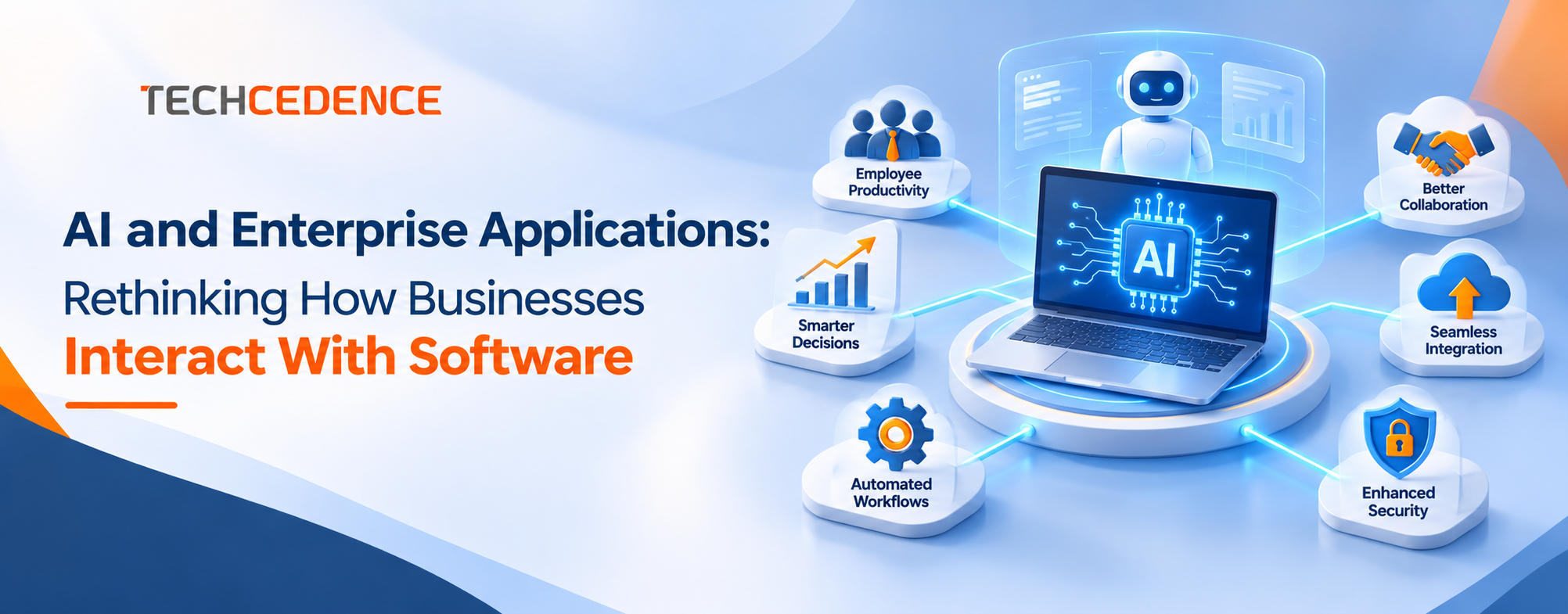
Artificial Intelligence (AI) is changing this experience by making enterprise applications more intuitive, responsive, and intelligent. Instead of simply helping users operate software, AI is enabling applications to understand requests, provide relevant insights, automate activities, and support better business decisions.
Moving Beyond Traditional Software Interfaces
Traditional enterprise applications are largely designed around structured menus, forms, dashboards, and predefined processes. Users need to understand how the application works before they can make full use of its capabilities.
AI introduces a more natural way of interacting with software. Employees can increasingly use conversational interfaces to ask questions, retrieve information, summarize reports, or initiate specific activities without navigating multiple sections of an application.
For example, instead of manually generating an inventory report, a user could ask an AI-powered application to identify products with low stock levels across multiple warehouses. Similarly, sales teams could request customer summaries, review pending opportunities, or access relevant account information through natural language interactions.
This shift reduces the effort involved in accessing business information and allows employees to focus more on tasks that require attention and decision-making.
Making Business Workflows More Intelligent
One of the most valuable applications of AI in enterprise software is workflow automation. Many business processes involve repetitive activities such as data entry, document processing, approvals, notifications, and information sharing.
AI can help improve these processes by identifying patterns, interpreting incoming information, recommending next steps, and automating selected activities.
Consider a field service operation where technicians receive multiple service requests throughout the day. An AI-enabled application can help analyze job priorities, technician availability, location, and service requirements to support better task allocation.
Similarly, in inventory management, AI can analyze historical consumption patterns, current stock levels, and demand fluctuations to help businesses make more informed replenishment decisions.
By combining automation with contextual intelligence, enterprise applications can become more effective at supporting day-to-day operations.
Better Decisions Through Contextual Insights
Businesses generate large volumes of information across departments, applications, and operational systems. However, having access to data does not automatically translate into better decisions.
Employees often spend considerable time collecting information from different sources, preparing reports, and identifying patterns before they can understand what is happening.
AI can simplify this process by analyzing available business data and presenting relevant insights in a more accessible format.
For instance, sales managers can use AI-powered insights to identify changes in sales performance, understand customer buying patterns, and recognize opportunities that may require attention. Operations teams can analyze resource utilization, identify recurring delays, and understand potential process inefficiencies.
Rather than relying entirely on manually generated reports, businesses can use intelligent applications to make information more actionable and support faster, better-informed decisions.
Connecting AI With Existing Enterprise Applications
Introducing AI into business operations does not necessarily mean replacing existing software systems. Most organizations already depend on applications that support important business processes, and replacing them can involve considerable time, cost, and operational disruption.
A more practical approach is to integrate AI capabilities into existing enterprise applications.
Through APIs, integrations, and customized development, businesses can connect AI functionality with their existing systems while retaining established workflows and data structures.
For example, AI capabilities can be incorporated into CRM platforms to assist with customer interactions, ERP systems to support operational analysis, and inventory applications to improve demand visibility.
However, successful integration requires attention to data quality, system compatibility, access controls, and security. AI capabilities must work reliably within the organization’s existing technology environment and deliver meaningful value to users.
The Importance of Human Oversight and Data Security
Although AI can improve application functionality, businesses must implement it thoughtfully. Not every business decision should be automated, particularly when it involves financial approvals, sensitive customer information, or critical operational activities.
Organizations need clear guidelines around data access, information security, user permissions, and the level of autonomy given to AI-powered systems.
Human oversight remains important for reviewing recommendations, validating critical outputs, and managing exceptions. Businesses should also ensure that AI-generated information is accurate, relevant, and aligned with organizational policies.
A well-planned implementation balances automation with accountability, allowing employees to benefit from AI without compromising control over business operations.
Preparing Enterprise Applications for the Next Phase of AI
The future of enterprise software will not be defined only by the number of features an application offers. Its value will increasingly depend on how effectively it helps people complete tasks, access information, collaborate, and make decisions.
Businesses should begin by identifying processes where employees spend excessive time navigating systems or performing repetitive activities. From there, they can evaluate opportunities to introduce conversational interfaces, intelligent automation, predictive insights, and AI-assisted workflows.
A gradual, business-focused approach allows organizations to measure improvements, address integration challenges, and expand AI adoption based on actual operational requirements.
The objective is not simply to add AI to existing software, but to make enterprise applications easier to use, more connected, and better aligned with business needs.
How Techcedence Can Help
At Techcedence, we help businesses build, enhance, and maintain enterprise applications that support evolving operational requirements. From custom application development and system integration to application maintenance, cloud solutions, and business process automation, our focus is on creating technology solutions that deliver practical business value.
As AI continues to reshape how organizations interact with software, businesses have an opportunity to make their applications more intelligent, connected, and efficient.
Looking to make your enterprise applications smarter and more effective? Connect with Techcedence to explore how AI integration and customized software solutions can help streamline workflows, improve decision-making, and support your business growth.