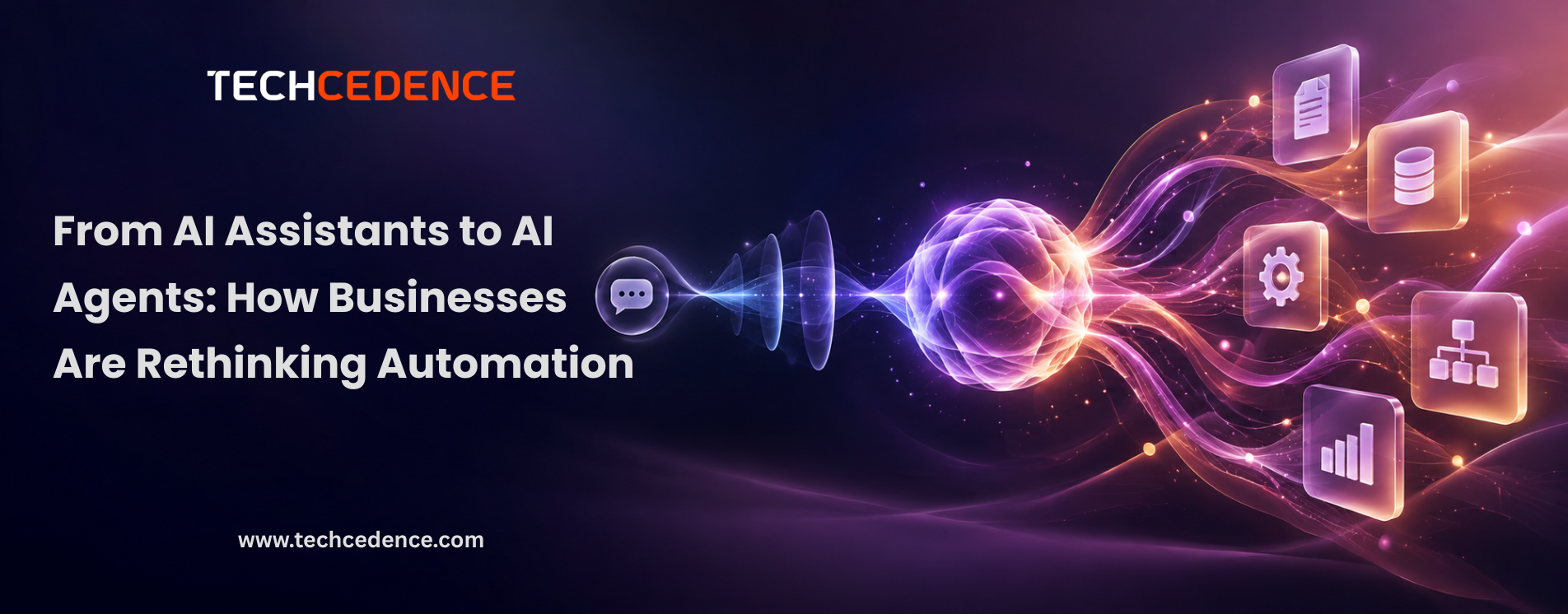
From AI Assistants to AI Agents: How Businesses Are Rethinking Automation
AI assistants have become increasingly common in business, helping employees draft content, summarize information, answer questions, analyze data, and complete routine tasks. They have made it easier for people to interact with technology using natural language rather than navigating complex processes.
But businesses are now looking beyond AI that simply responds to requests. The next stage is AI agents, which can work toward a defined objective, decide what steps are needed, use connected tools, and carry out actions with limited human intervention.
This represents a broader change in how organizations think about automation. Instead of using AI only to support individual tasks, businesses are beginning to explore how it can participate in complete workflows, respond to changing conditions, and help manage outcomes.
AI Assistants and AI Agents Are Not the Same
The difference between an AI assistant and an AI agent is mainly about how much responsibility the system can take within a workflow. An AI assistant typically waits for a user request and provides information, recommendations, or content in response. The user remains responsible for deciding what happens next.
An AI agent can operate toward a defined goal by determining the steps required to achieve it. It may gather information from different systems, use available tools, evaluate the results, and take the next appropriate action.
For example, an assistant can help a sales employee write a follow-up email. An agent could identify customers requiring follow-up, review relevant account information, prepare the message, update the sales system, and route the activity for approval.
The distinction is therefore not simply about intelligence. It is about moving from providing assistance to participating in the execution of a workflow.
Why Traditional Automation Has Its Limits
Traditional automation is highly effective when a process follows predictable rules. Tasks such as sending scheduled notifications, moving data between systems, or generating routine reports can be handled reliably when the required conditions are clearly defined.
The challenge arises when workflows involve changing information, exceptions, or decisions that cannot be covered by a fixed set of rules. A delayed payment, an unusual customer request, or a system issue may require someone to assess the situation before deciding what should happen next.
As processes become more complex, businesses often end up adding more rules and manual checkpoints to handle these situations. This can make automation harder to maintain and still leave employees responsible for coordinating exceptions.
AI agents offer a different approach by enabling automated workflows to respond to context and changing conditions rather than depending entirely on predefined paths.
What AI Agents Bring to Business Workflows
AI agents can extend automation from individual tasks to complete workflows. Instead of waiting for an employee to initiate every step, an agent can work toward a defined objective by gathering information, evaluating the situation, using connected tools, and progressing through the required actions.
For example, an agent handling a service request could review the customer’s history, identify the issue, check relevant records, suggest a resolution, and create an appropriate service action. If the situation falls outside its defined boundaries, it can hand the decision to an employee.
This ability to coordinate multiple steps makes AI agents particularly useful for processes that involve several systems, decisions, and actions. The value comes not from automating one task, but from reducing the manual coordination required to move a workflow from one stage to the next.
Where Businesses Can Apply AI Agents
AI agents can be useful across business functions where work involves multiple steps, changing information, and repeated decision-making. In customer service, an agent can understand a request, retrieve relevant account information, resolve routine issues, and escalate cases that require human attention.
In sales, agents can research prospects, prepare account summaries, update CRM records, and support follow-up activities. Operations teams can use them to monitor processes, identify exceptions, and coordinate the next action. Finance teams can apply agents to document processing, reconciliation, and anomaly identification, while IT teams can use them to investigate incidents and execute routine support procedures.
The opportunity is to identify workflows where employees spend significant time coordinating information and actions, rather than simply looking for tasks that can be automated in isolation.
Rethinking the Human Role in Automated Workflows
AI agents can handle more parts of a workflow, but that does not mean every decision should be handed over to AI. Businesses still need people for decisions that involve judgment, accountability, sensitive information, or significant financial and operational consequences.
This creates a human-in-the-loop approach, where agents manage routine execution while employees review important decisions or intervene when a situation falls outside defined boundaries. For example, an agent might prepare a purchase recommendation, but a manager could approve the final order.
This approach allows businesses to gain efficiency without removing human oversight. The goal is not to eliminate people from workflows, but to give them more time for decisions that require experience, context, and responsibility.
The Data and Systems AI Agents Need to Work
AI agents cannot operate effectively on intelligence alone. They need access to reliable business information and the systems where relevant actions take place. If customer records are incomplete, inventory data is outdated, or applications remain disconnected, an agent may struggle to make appropriate decisions.
This makes the underlying digital environment an important part of an agent strategy. Businesses may need to connect applications through APIs, organize internal knowledge, establish clear data access, and define which systems an agent can interact with.
A strong foundation also helps organizations control what agents can see and do. Rather than treating AI agents as a standalone technology, businesses need to consider how they fit into their existing data, applications, and operational architecture.
Moving From AI Experiments to Agentic Automation
Businesses do not need to introduce AI agents across every process at once. A more practical approach is to begin with workflows that have clear objectives, measurable outcomes, and manageable risks.
Organizations can identify processes where employees spend significant time collecting information, coordinating steps, or handling repetitive decisions. These workflows can then be tested with limited agent responsibilities and appropriate human oversight.
Performance can be evaluated through measures such as processing time, accuracy, workload reduction, and operational outcomes. As the technology proves reliable, businesses can gradually expand the agent’s responsibilities.
This step-by-step approach allows organizations to move beyond AI experimentation and build agentic automation around processes where it can deliver measurable business value.