Why Enterprise Analytics Needs a Strong Data Architecture
Enterprise analytics is becoming essential for organizations that want to make faster and more informed business decisions. However, having dashboards, reports, and business intelligence tools does not automatically guarantee reliable insights. The effectiveness of those insights relies significantly on the methods used for data collection, organization, integration, and management.
As businesses generate data across applications, departments, cloud platforms, and connected systems, fragmented information can make analytics difficult to scale. A strong data architecture provides the foundation needed to bring this information together, maintain consistency, and make trusted data accessible for analysis.
Why Analytics Projects Often Struggle
Many enterprise analytics projects struggle because data is spread across disconnected systems. Different departments may use separate applications, formats, and definitions, making it difficult to create a consistent view of business information.
Data preparation can also become a major challenge. Teams may spend significant time collecting, cleaning, and reconciling information before it can be used for analysis. With the increasing volume and variety of data, it becomes increasingly difficult to sustain these manual processes, which can lead to errors.
Without a well-planned data foundation, analytics teams can spend more time fixing data problems than generating meaningful business insights.
What a Strong Data Architecture Provides
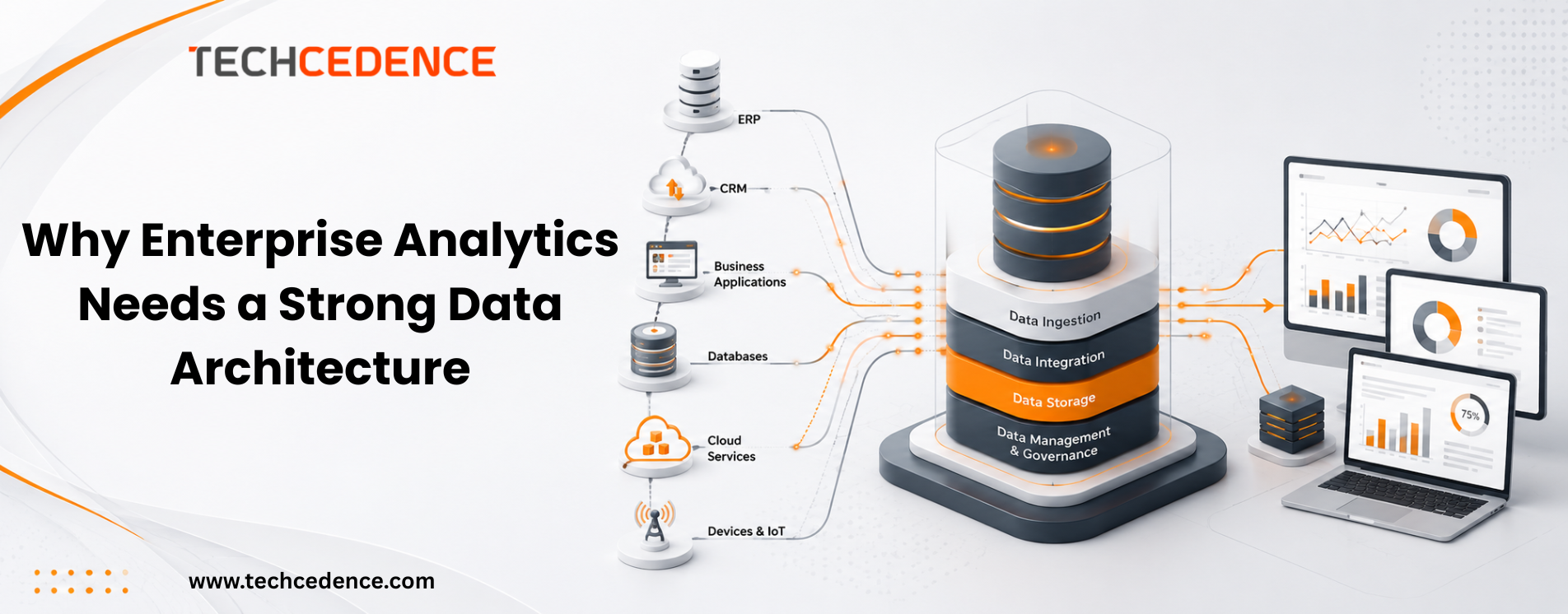
A strong data architecture creates a structured framework for how enterprise data is collected, stored, integrated, and accessed. It connects information from different systems while maintaining consistent definitions and standards across the organization.
This foundation makes trusted data easier to access for reporting and analysis. It also establishes clear data flows, reducing duplication and improving consistency across analytics environments.
More importantly, a well-designed architecture can evolve with the organization. As new applications, data sources, and analytics requirements emerge, the architecture provides a flexible foundation that allows businesses to expand their analytics capabilities without rebuilding their data environment from the ground up.
Connecting Data Sources Across the Enterprise
Enterprise data often comes from a wide range of sources, including ERP systems, CRM platforms, business applications, cloud services, and connected devices. When these sources operate independently, valuable information remains scattered across the organization.
A strong data architecture connects these sources through structured data pipelines and integration processes. This allows information to move consistently between operational systems and analytics environments while reducing duplicate or conflicting records.
With connected data sources, organizations can develop a more complete view of their operations, customers, and performance. This provides analytics teams with the broader context needed to generate meaningful insights and supports more consistent decision-making across departments.
Data Quality and Governance as the Foundation
Connected data is useful only when organizations can trust it. Inconsistent formats, duplicate records, outdated information, and unclear ownership can quickly reduce the reliability of analytics, even when the underlying architecture is well connected.
Data governance establishes the standards and responsibilities needed to maintain data quality. Clear definitions, validation processes, and ownership help ensure that teams work with consistent information and interpret key business metrics in the same way.
Good governance should support analytics rather than create unnecessary barriers. When quality and accountability are built into the data architecture, organizations can provide decision-makers with information they can use with greater confidence.
Designing Architecture for Scale and Flexibility
Enterprise data requirements rarely remain static. As organizations grow, they add new applications, generate larger volumes of information, and introduce new analytics requirements. A data architecture that works today must therefore be capable of adapting to future needs.
Scalable architecture allows businesses to expand data storage, processing, and integration capabilities without disrupting existing analytics workflows. Adaptable designs also facilitate the integration of new data sources and technologies as they become available.
Planning for scale from the beginning helps organizations avoid costly restructuring later and creates a data environment that can support evolving analytics needs over the long term.
From Data Architecture to Actionable Analytics
A strong data architecture creates the conditions for analytics to deliver meaningful business value. When data is integrated, consistent, and readily accessible, teams can spend less time preparing information and more time interpreting what it means for the business.
Reliable data also improves the usefulness of dashboards and BI platforms. Decision-makers can track performance using consistent metrics, identify emerging trends, and respond to changes with greater confidence. The same foundation can support more advanced analytics initiatives as organizations mature.
Data Analytics and BI solutions, offered by Techcedence, can help turn a well-structured data environment into actionable business insights. The value comes from connecting reliable data with the right analytical capabilities and business objectives.
Building a Data Architecture That Supports Business Goals
A data architecture should be designed around the decisions an organization needs to make, rather than technology alone. Businesses should first identify their most important analytics requirements, critical data sources, and areas where better information can create measurable value.
A phased approach can make implementation more practical. Organizations can begin with high-priority use cases, establish reliable data flows, and gradually expand the architecture as requirements evolve. This reduces disruption while creating a foundation for future analytics initiatives.
Regularly reviewing the architecture is also important. As business processes, applications, and data requirements change, the data foundation should evolve with them to remain useful, scalable, and aligned with organizational goals.
Conclusion
Enterprise analytics is only as effective as the data foundation behind it. Dashboards and BI tools can present information, but a strong data architecture ensures that the information is reliable, connected, accessible, and ready to scale.
By integrating data sources, maintaining quality and governance, and designing for future growth, organizations can build analytics environments that support confident decision-making. As data continues to become central to business strategy, a well-designed architecture is no longer just a technical foundation. It is an essential part of building a scalable, data-driven enterprise.